What’s My Ethnicity? A Complete Guide to Discovering Your Heritage


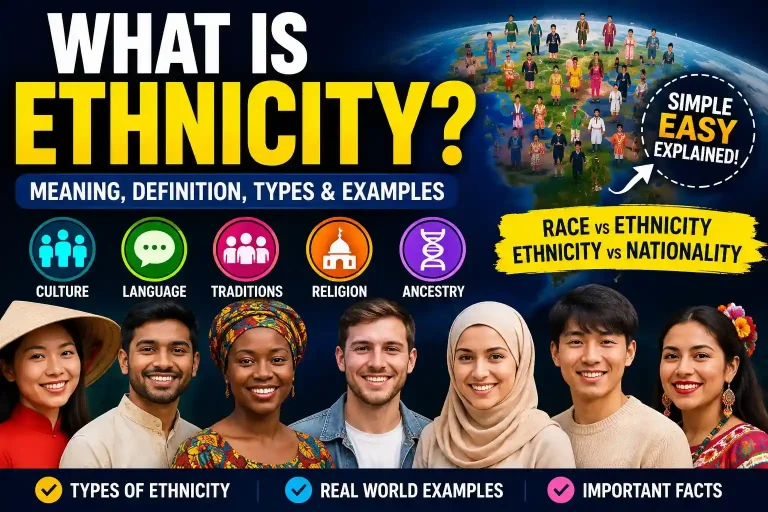
If you’re asking “what’s my ethnicity,” the answer lies in your family’s shared culture, ancestry, language, and traditions — not just your appearance. Ethnicity refers to your identification with a specific group of people based on shared traits such as ancestry, culture, language, religion, and customs. Unlike race, which is largely about physical characteristics, ethnicity is about the cultural heritage you inherit and the community you belong to. This guide explains what ethnicity means, how it differs from race and nationality, and the practical steps you can take to discover your own ethnic background — whether you’re adopted, from a mixed family, or simply curious about your roots.
What Does “What’s My Ethnicity” Mean?
When someone asks “what’s my ethnicity,” they are really asking: which cultural group do I belong to? Your ethnicity is the story of where your family comes from — the languages your grandparents spoke, the foods your family eats at holidays, the traditions you grew up with, and the ancestral homelands your forebears left behind. A person might be racially Black but ethnically Haitian, Jamaican, or African-American; racially white but ethnically Irish, Italian, or Jewish; racially Asian but ethnically Vietnamese, Korean, or Filipino. Ethnicity captures that cultural layer.
The term itself comes from the Greek word ethnos, meaning a nation, tribe, or people. As Britannica explains, ethnicity is a complex concept shaped by historical, political, social, and cultural factors — it is about both your personal affiliation with a group and the group’s reciprocal acknowledgment of shared origins. In other words, ethnicity is partly what you feel inside and partly what your community recognizes. For a deeper breakdown of the concept itself, see our guide on what an ethnicity is.
Many people asking this question are adopted, are the children of immigrants, come from mixed families, or simply never learned their family history. There is no shame in not knowing — and today there are more tools than ever to find out, from DNA testing to genealogical research to simple conversations with older relatives.
Ethnicity vs. Race vs. Nationality
One of the biggest sources of confusion is the difference between ethnicity, race, and nationality — three related but distinct concepts. Race is a socially constructed category based on physical traits like skin color and facial features (e.g., Black, white, Asian). Ethnicity is about shared culture: ancestry, language, religion, customs, and a sense of shared history (e.g., Korean, Yoruba, Ashkenazi Jewish, Mexican). Nationality is about citizenship — the country whose passport you hold (e.g., American, Canadian, Nigerian).
These can overlap or diverge. A person born in the United States to Korean immigrant parents has American nationality, Asian race (in U.S. census terms), and Korean ethnicity. Someone like basketball star Ramtin Abdolmajid carries a heritage story distinct from his public profile, just as Dorothée Lepère‘s background reflects a different European cultural lineage — both illustrate how ethnicity adds the cultural dimension that race and nationality alone miss. Understanding all three gives you the full picture of identity.
How to Discover Your Ethnicity: 7 Practical Steps
1. Talk to your family. Start with the oldest generation. Ask your parents, grandparents, aunts, and uncles where the family came from, what languages were spoken at home, and what traditions they remember. Family stories — even vague ones — are the fastest route to your ethnic roots. Record these conversations if you can; details fade.
2. Take a DNA test. Autosomal DNA tests from companies like AncestryDNA, 23andMe, and MyHeritage analyze your genetic markers and estimate your ethnic breakdown by region (e.g., 40% Irish, 25% Nigerian, 20% Ashkenazi Jewish). These tests are remarkably accessible today and can reveal ancestries your family never mentioned. Keep in mind they estimate genetic ancestry, which overlaps with but is not identical to ethnicity — a cultural concept.
3. Research your family tree. Census records, immigration manifests, birth and marriage certificates, and military records can trace your ancestors back generations. Free resources like FamilySearch and national archives are excellent starting points. Surnames alone can be clues: a name like Paterniti points to Sicily; Nguyen to Vietnam; O’Brien to Ireland.
4. Explore your family’s culture. Ethnicity is lived, not just inherited. Cook your family’s traditional foods, learn a few phrases of the ancestral language, observe the holidays, and listen to the music. Cultural practice is what turns ancestry into ethnicity.
5. Consider the history. Learn about the historical events that shaped your family’s migrations — wars, famines, economic upheavals, colonial histories. Understanding why your ancestors moved gives meaning to where they came from.
6. Connect with community. Cultural organizations, religious institutions, language classes, and community festivals for your suspected ethnic group can provide belonging and knowledge no test can deliver.
7. Use an ethnicity guesser tool. Curious about how the world perceives your background? Try an ethnicity guesser for a fun, informal take — just remember these tools guess from appearance, which is only one small part of true ethnicity.

Why People Don’t Know Their Ethnicity
There are many legitimate reasons someone might not know their ethnic background. Adoptees may have no access to biological family records. Children of immigrants sometimes grow up assimilated, with parents who deliberately left the old culture behind to fit in. Families with painful histories — war, persecution, displacement — may have buried the past. And in mixed families, one parent’s heritage can easily overshadow the other’s within a generation or two.
Enslaved peoples’ descendants face a particular challenge: the transatlantic slave trade deliberately severed Africans from their specific ethnic origins, which is why many Black Americans identify ethnically as African-American — a distinct ethnicity forged in America — rather than with a specific African group. DNA testing has helped some reconnect with specific regions, but the cultural ethnicity remains African-American.
Whatever your situation, not knowing is a starting point, not a verdict. Millions of people are reconstructing their heritage right now, and the journey itself — the conversations, the research, the discoveries — often becomes as meaningful as the answer.
Can Ethnicity Change?
Ethnicity is partly inherited and partly chosen. You cannot change your ancestry — your DNA is fixed — but ethnic identity can evolve. A person raised in one culture who marries into another, learns its language, and raises children in its traditions may come to identify with that ethnicity too. Sociologists call this “ethnic options” or “situational ethnicity”: the idea that identity is negotiated, not just assigned.
This is especially true for mixed-heritage people, who may emphasize different parts of their background in different contexts — a reality familiar to many of the public figures profiled on this site. The key insight: ethnicity is a story you inherit and a story you tell. Both matter.

What’s My Ethnicity: Quick Reference
| Question | Answer |
|---|---|
| What is ethnicity? | Your cultural group identity based on shared ancestry, language, traditions, and customs |
| How is it different from race? | Race is about physical traits; ethnicity is about shared culture and heritage |
| How is it different from nationality? | Nationality is citizenship; ethnicity is cultural belonging |
| Best first step to find out? | Talk to older relatives about family origins and traditions |
| Can a DNA test tell me? | It estimates genetic ancestry by region — a strong clue, but not the whole cultural picture |
| Can I have more than one? | Yes — most people have multiple ethnic heritages, especially in multicultural societies |
Frequently Asked Questions (FAQ)
How do I find out what my ethnicity is?
Start by asking older family members about your family’s origins, languages, and traditions. Then consider a DNA test (AncestryDNA, 23andMe, or MyHeritage) and genealogical research through census and immigration records. Combining family stories with genetic and documentary evidence gives the fullest picture.
Is ethnicity the same as race?
No. Race refers to socially defined categories based on physical characteristics like skin color, while ethnicity refers to shared cultural heritage — ancestry, language, religion, customs, and a sense of common history. You can share a race with someone of a completely different ethnicity.
What if my DNA test shows unexpected results?
Unexpected results are common — family stories are sometimes incomplete or wrong. Treat surprises as new leads, not verdicts. Genetic ancestry estimates have margins of error and reflect ancient population patterns, not just recent family history. Discuss findings with relatives and corroborate with records.
Can I claim an ethnicity I wasn’t raised in?
Ethnic identity involves both ancestry and cultural connection. Many people with mixed or distant heritage choose to learn about and embrace all parts of their background — learning the language, customs, and history. Respectful engagement with the culture is key; claiming identity without any connection or understanding can feel hollow to community members.
What’s the difference between ethnicity and nationality?
Nationality is your country of citizenship — the passport you hold. Ethnicity is your cultural group — the heritage, language, and traditions you identify with. A single nationality (like American or British) contains hundreds of ethnicities.
For authoritative definitions, see Britannica’s article on ethnicity.
She holds advanced qualifications in Sociology, Anthropology, and Ethnic Studies, fields that focus on human cultures, traditions, migration patterns, and identity development across the world. Her expertise allows her to break down complex cultural topics into easy-to-understand articles that readers genuinely enjoy.
Over the years, Milana has researched hundreds of public figures, communities, and global ethnic groups, making her a trusted voice in the ethnicity niche. Her writing combines factual research, historical understanding, and modern cultural analysis to ensure every article is informative, reliable, and reader-friendly.
Her work focuses on:
* Ethnicity and ancestry research
* Cultural identity and heritage
* Nationality and family background
* Celebrity ethnicity breakdowns
* Global traditions and multicultural studies
Milana’s goal is to provide readers with authentic, well-researched, and trustworthy information while celebrating the diversity of cultures around the world. Through her detailed research and passion for cultural education, she continues to help audiences better understand ethnicity, heritage, and identity in today’s connected world.
- Larry Ellison Ethnicity: Jewish Mother and Italian Father - October 6, 2026
- Charlie Heaton Ethnicity: Nationality, Parents & Background - October 6, 2026
- Hilaria Baldwin Ethnicity: Heritage, Parents & Background Explained - October 6, 2026