Cape Verde Ethnicity Explained: African, Portuguese, Mixed Race & Cultural Origins

Cape Verde Ethnicity: Understanding the Unique Identity of Cape Verdeans
When people search for Cape Verde ethnicity, they often ask a simple question: Are Cape Verdeans African, Portuguese, Black, or mixed race?
The answer is more complex than many expect.
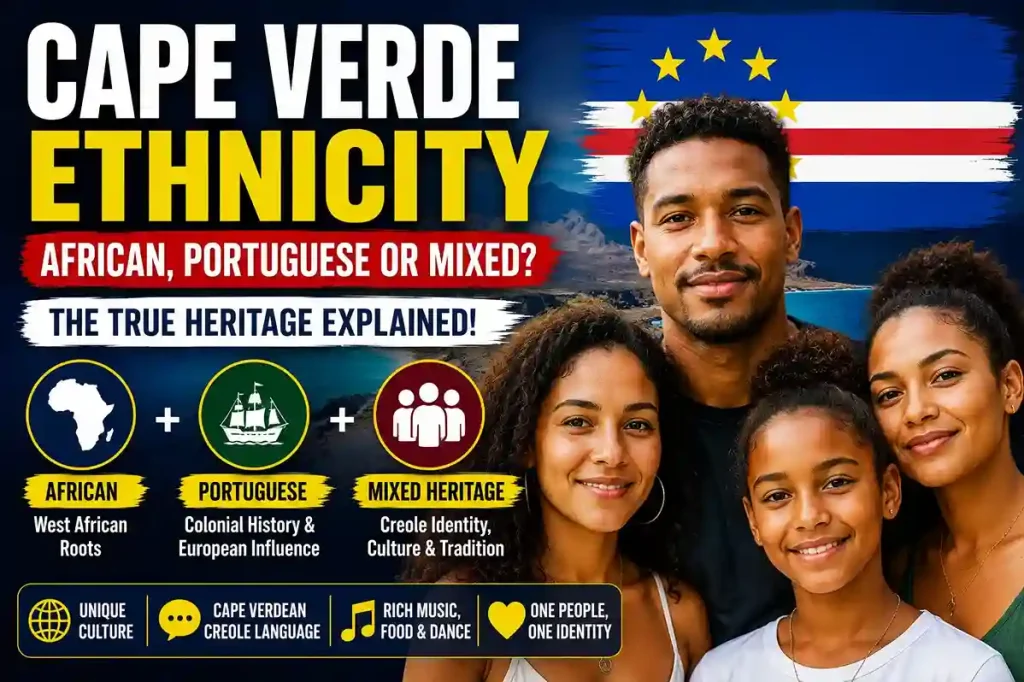
Cape Verde has one of the most unique ethnic identities in the world. Located off the west coast of Africa in the Atlantic Ocean, the country developed through centuries of interaction between African populations and Portuguese settlers. As a result, most Cape Verdeans today identify as mixed-race people with both African and European ancestry, although the exact ethnic composition varies from family to family.
This rich blend of cultures, languages, and traditions has created a distinct Cape Verdean identity that is neither entirely African nor entirely European but uniquely Cape Verdean.
In this guide, we’ll explore the history, ethnic makeup, ancestry, race, culture, language, and identity of Cape Verde and its people.
Quick Facts About Cape Verde
| Detail | Information |
|---|---|
| Official Name | Republic of Cabo Verde |
| Location | Atlantic Ocean, West Africa |
| Capital | Praia |
| Population | Approximately 600,000 |
| Official Language | Portuguese |
| Main Ethnicity | Mixed African and European |
| Former Colonial Power | Portugal |
| Independence | 1975 |
| Major Religion | Christianity |
| Demonym | Cape Verdean |
What Is Cape Verde Ethnicity?
The majority of Cape Verdeans belong to a mixed ethnic group known as Mestiço or Creole.
This population emerged through centuries of interaction between:
- West African peoples
- Portuguese settlers
- European traders
- Enslaved Africans brought to the islands
Because the islands were largely uninhabited before Portuguese arrival in the 15th century, Cape Verde developed differently from many African countries.
Today, most Cape Verdeans have both African and European ancestry.
Ethnic Composition of Cape Verde
| Ethnic Group | Estimated Percentage |
|---|---|
| Mixed African-European (Mestiço) | Majority |
| African | Significant Minority |
| European | Small Minority |
| Other Groups | Very Small |
Unlike many nations where ethnic divisions are clearly defined, Cape Verde has evolved into a society where mixed ancestry is common.
Are Cape Verdeans African?
Yes.
Cape Verde is geographically located in Africa and is a member of the African Union.
Most Cape Verdeans have significant African ancestry, particularly from West African populations such as:
- Mandinka
- Wolof
- Fulani
- Serer
- Other Senegambian groups
Because of this heritage, Cape Verdeans are culturally and historically connected to Africa.
However, their identity is also influenced by centuries of Portuguese colonial history.
Are Cape Verdeans Portuguese?
Cape Verdeans are generally not considered Portuguese ethnically, but Portuguese influence remains extremely important.
Portugal colonized Cape Verde beginning in the 15th century.
Portuguese settlers contributed:
- Language
- Religion
- Architecture
- Cuisine
- Family names
- Cultural traditions
Many Cape Verdeans therefore possess partial Portuguese ancestry, but they maintain a separate national and ethnic identity.
Today, Cape Verde is an independent nation with its own unique culture.
Are Cape Verdeans Black?
Some Cape Verdeans identify as Black, while others identify as mixed race.
The answer often depends on:
- Family ancestry
- Personal identity
- Cultural background
- Country of residence
In the United States, many Cape Verdean Americans identify as Black due to their African heritage.
Others emphasize their mixed-race identity because of their European ancestry.
There is no single answer that applies to every Cape Verdean family.
The Origins of Cape Verde Ethnicity
To understand Cape Verde ethnicity, it is important to understand the country’s history.
Portuguese Discovery
Portuguese explorers discovered the islands around 1456.
At the time, the islands were uninhabited.
Portugal quickly established settlements and used Cape Verde as a strategic trading hub.
The Atlantic Slave Trade
Cape Verde became an important center in the transatlantic slave trade.
Thousands of enslaved Africans were transported through the islands.
Over time, interactions between Europeans and Africans created a new mixed population.
This population eventually became the foundation of modern Cape Verdean society.
Development of a Creole Society
Unlike many colonies where Europeans remained socially separate, Cape Verde developed a large mixed-race population.
Over generations, a distinct Creole culture emerged.
This culture blended:
- African traditions
- Portuguese customs
- Local island influences
The result was a completely unique ethnic identity.
What Race Are Cape Verdeans?
Race and ethnicity are different concepts.
Cape Verdeans can belong to multiple racial categories depending on their ancestry.
Some may identify as:
- Black
- Mixed race
- Afro-European
- Multiracial
Ethnically, however, most identify as Cape Verdean.
This national identity often transcends traditional racial classifications.
Cape Verde Language and Ethnicity
Language plays a major role in Cape Verdean identity.
Portuguese
Portuguese is the country’s official language.
It is used in:
- Government
- Education
- Business
- Media
Cape Verdean Creole
Most citizens speak Cape Verdean Creole in everyday life.
The language combines:
- Portuguese vocabulary
- African linguistic influences
Creole serves as one of the strongest symbols of Cape Verdean identity.
Cape Verde Culture
Cape Verdean culture reflects centuries of cultural blending.
Important influences include:
African Traditions
- Music
- Dance
- Storytelling
- Community values
Portuguese Traditions
- Religion
- Language
- Architecture
- Cuisine
Island Influences
- Maritime lifestyle
- Fishing culture
- Migration traditions
Together, these influences create a culture unlike any other in Africa.
Religion in Cape Verde
Most Cape Verdeans are Christians.
The dominant religion is Roman Catholicism, introduced during Portuguese rule.
Religion remains an important part of family and community life throughout the islands.
Famous People of Cape Verdean Ethnicity
Cape Verde has produced many influential figures worldwide.
Cesária Évora
Cesária Évora
Known as the “Barefoot Diva,” she introduced Cape Verdean music to global audiences.
Pedro Pires
Pedro Pires
A key leader in Cape Verde’s independence movement.
Vozinha
Vozinha
The veteran goalkeeper gained international attention after heroic performances for Cape Verde on the world stage.
Cape Verde Diaspora
One remarkable aspect of Cape Verdean identity is migration.
Today, more Cape Verdeans live abroad than within Cape Verde itself.
Large communities exist in:
- United States
- Portugal
- France
- Netherlands
- Luxembourg
- Italy
These communities help preserve Cape Verdean culture worldwide.
Cape Verde Ethnicity vs Nationality
Many people confuse ethnicity and nationality.
Nationality
Nationality refers to citizenship.
Examples:
- Cape Verdean
- American
- Portuguese
Ethnicity
Ethnicity refers to ancestral and cultural background.
For Cape Verdeans, ethnicity is generally a mixture of:
- African ancestry
- European ancestry
- Creole heritage
Why Cape Verde Ethnicity Is Unique
Few countries have developed the same ethnic composition as Cape Verde.
Its identity is unique because:
- The islands were originally uninhabited.
- African and European populations mixed for centuries.
- A distinct Creole culture emerged.
- Language evolved separately.
- Strong migration shaped modern identity.
These factors make Cape Verde one of the world’s most fascinating multicultural societies.
Frequently Asked Questions
What ethnicity are Cape Verdeans?
Most Cape Verdeans are of mixed African and European ancestry, commonly referred to as Creole or Mestiço.
Are Cape Verdeans African?
Yes. Cape Verde is an African country, and most citizens have significant African ancestry.
Are Cape Verdeans Portuguese?
No. They are Cape Verdean, although Portuguese influence remains strong due to colonial history.
Are Cape Verdeans Black?
Some identify as Black, while others identify as mixed race depending on their ancestry and personal identity.
What language do Cape Verdeans speak?
Portuguese and Cape Verdean Creole.
What race are Cape Verdeans?
Cape Verdeans may identify as Black, mixed race, Afro-European, or multiracial.
Is Cape Verde part of Africa?
Yes. Cape Verde is an independent African nation located in the Atlantic Ocean off the coast of West Africa.
Final Thoughts
The story of Cape Verde ethnicity is a story of cultural fusion, resilience, and identity. Cape Verdeans are primarily descendants of both West African peoples and Portuguese settlers, creating one of the world’s most distinctive Creole populations.
While many people try to classify Cape Verdeans as simply African, Portuguese, Black, or mixed race, the reality is more nuanced. Cape Verdean identity is a unique blend of all these influences, shaped by centuries of history, migration, and cultural exchange.
Today, Cape Verde stands as a powerful example of how diverse peoples and traditions can combine to create a vibrant national identity that is recognized and celebrated around the world.
She holds advanced qualifications in Sociology, Anthropology, and Ethnic Studies, fields that focus on human cultures, traditions, migration patterns, and identity development across the world. Her expertise allows her to break down complex cultural topics into easy-to-understand articles that readers genuinely enjoy.
Over the years, Milana has researched hundreds of public figures, communities, and global ethnic groups, making her a trusted voice in the ethnicity niche. Her writing combines factual research, historical understanding, and modern cultural analysis to ensure every article is informative, reliable, and reader-friendly.
Her work focuses on:
* Ethnicity and ancestry research
* Cultural identity and heritage
* Nationality and family background
* Celebrity ethnicity breakdowns
* Global traditions and multicultural studies
Milana’s goal is to provide readers with authentic, well-researched, and trustworthy information while celebrating the diversity of cultures around the world. Through her detailed research and passion for cultural education, she continues to help audiences better understand ethnicity, heritage, and identity in today’s connected world.
- Jelly Roll and Bunnie Divorce: What We Know About Their Marriage - September 12, 2026
- Liam Neeson and Pamela Anderson: Their Relationship, The Naked Gun, and Where They Stand Now - September 11, 2026
- Kylie Jenner and Timothée Chalamet: Their Relationship, Timeline, and Latest Update - September 11, 2026