Leonardo DiCaprio Ethnicity: The Italian, German, and Russian Roots of the Oscar Winner

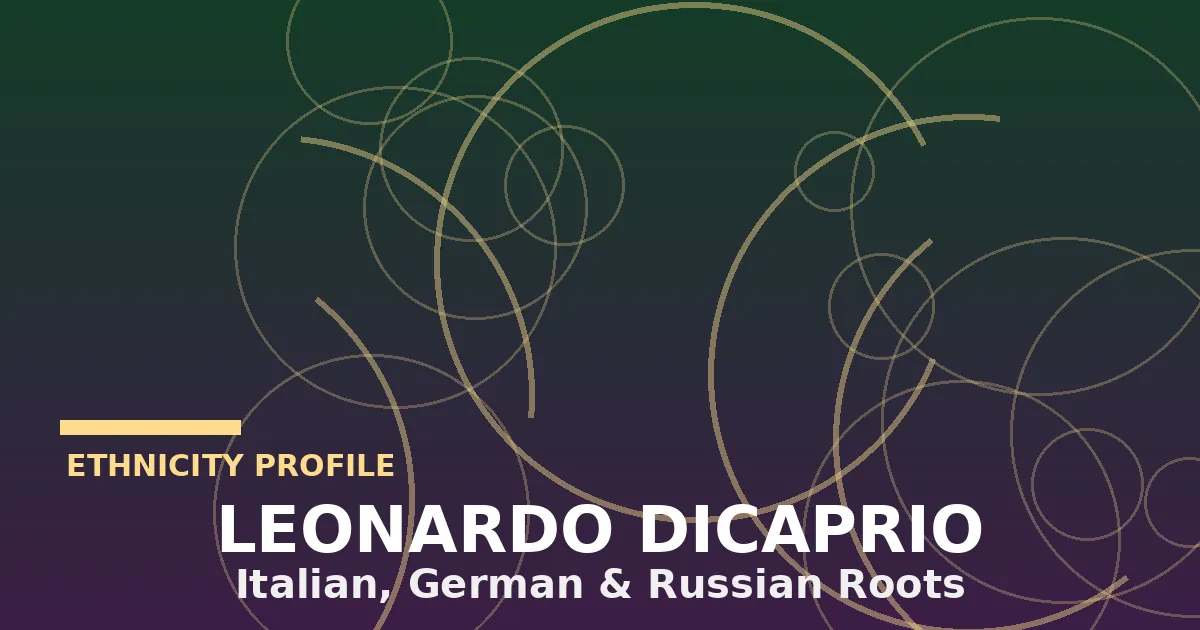
Leonardo DiCaprio is of mixed Italian, German, and Russian ethnicity. Born on November 11, 1974, in Los Angeles, California, the Academy Award-winning actor inherited Italian and German ancestry from his father, George DiCaprio, and German and Russian ancestry from his German-born mother, Irmelin Indenbirken. His maternal grandmother, Helene Indenbirken (born Yelena Smirnova), was a Russian-born German citizen — a heritage DiCaprio has acknowledged himself, once telling a Russian audience that he considers himself “half-Russian.” His thoroughly European background shaped a childhood split between Los Angeles and Germany and a career that made him one of the most famous actors on the planet.
| Detail | Information |
|---|---|
| Full name | Leonardo Wilhelm DiCaprio |
| Born | November 11, 1974, Los Angeles, California, USA |
| Nationality | American |
| Ethnicity | Italian, German, and Russian descent |
| Parents | George DiCaprio (Italian/German) and Irmelin Indenbirken (German/Russian) |
| Known for | Titanic, Inception, The Revenant (Oscar win), The Wolf of Wall Street |
Who Is Leonardo DiCaprio?
Leonardo Wilhelm DiCaprio is an American actor and film producer whose career has spanned more than three decades, from child actor to one of Hollywood’s most bankable and acclaimed leading men. After early television work on shows like Growing Pains and a film debut in Critters 3 (1991), he broke through with This Boy’s Life (1993) and an Oscar-nominated turn in What’s Eating Gilbert Grape (1993), then became a global phenomenon as Jack Dawson in Titanic (1997).
Rather than coasting on heartthrob status, DiCaprio rebuilt himself as a serious actor through collaborations with Martin Scorsese (Gangs of New York, The Aviator, The Departed, The Wolf of Wall Street, Killers of the Flower Moon), Christopher Nolan (Inception), and Alejandro González Iñárritu, whose The Revenant (2015) finally earned him the Academy Award for Best Actor after five previous nominations. He is also a prominent environmental activist through the Leonardo DiCaprio Foundation, focused on climate change and conservation.
His name itself tells an ethnic story: “Leonardo” came to his pregnant mother while she was viewing a Leonardo da Vinci painting in an Italian museum and felt him kick, and “Wilhelm” honors his German maternal grandfather. Few Hollywood names encode heritage quite so literally.
Early Life and Family Background
Leonardo DiCaprio was born on November 11, 1974, in Los Angeles, the only child of Irmelin Indenbirken, a legal secretary, and George DiCaprio, an underground comic-book artist, distributor, and performance artist. His parents met in college and moved to Los Angeles, but separated when Leonardo was about a year old; he was raised primarily by his mother in working-class Los Angeles neighborhoods including Echo Park and Los Feliz, while his mother worked multiple jobs.
Despite the modest circumstances, DiCaprio’s childhood was culturally rich and binational. He spent parts of his youth in Germany with his maternal grandparents, Wilhelm and Helene Indenbirken, an experience that left him conversant in German (and Italian) and gave him a genuine second homeland. His father, meanwhile, remained a colorful presence — a fixture of the underground comix scene who was even depicted in Harvey Pekar’s American Splendor.
An early brush with Hollywood prejudice became family legend: when a young DiCaprio finally landed an agent, he was told his name was “too ethnic” and that he should perform as “Lenny Williams.” His father reportedly tore up the rebranded headshots, declaring “over my dead body” — a story DiCaprio himself recounted on the New Heights podcast in 2025. The name stayed, and the ethnicity it announced became iconic.
What Is Leonardo DiCaprio’s Ethnicity?
Leonardo DiCaprio’s ethnicity is a mix of Italian, German, and Russian. His father, George DiCaprio, is of Italian descent (with family roots in the Naples/Campania region) and German descent (Bavarian roots on his mother’s side). His mother, Irmelin (née Indenbirken), was born in Germany in the aftermath of World War II to a German father, Wilhelm Indenbirken, and a Russian-born mother, Helene Indenbirken (née Yelena Smirnova, 1915–2008), who emigrated from Russia to Germany.
DiCaprio has personally embraced the Russian thread: in an interview in Russia, he described himself as “half-Russian,” noting that two of his grandparents were Russian — a characteristically generous rounding that speaks to how strongly he identifies with that side of the family. His maternal grandmother Helene, the Russian émigré, was a particularly important figure in his German childhood summers.
The result is an actor whose heritage spans Southern, Central, and Eastern Europe — Italian passion, German discipline, Russian soul, as the cliché might have it — and whose very name announced his ethnicity to an industry that once asked him to hide it. He is American by nationality and European by blood, a combination that has arguably helped him disappear into roles from 19th-century frontiersmen to 1920s stock swindlers.
Career Highlights
DiCaprio’s filmography is among the most decorated of his generation. After the one-two punch of Romeo + Juliet (1996) and Titanic (1997) made him the world’s biggest young star, he deliberately pivoted to auteur-driven work: Catch Me If You Can (2002), The Aviator (2004), Blood Diamond (2006), Inception (2010), Django Unchained (2012), The Great Gatsby (2013), and Once Upon a Time in Hollywood (2019) — a run of commercial and critical successes with few parallels.
The Oscar finally came in 2016 for The Revenant, his sixth nomination, ending one of Hollywood’s most memed droughts. Through his Appian Way production company, he has also shepherded films and documentaries, many with environmental themes. His activism — from addressing the UN on climate change to funding conservation projects worldwide — has made him as influential off-screen as on it, with his Russian heritage occasionally surfacing in his conservation diplomacy, including meetings with Vladimir Putin on tiger conservation.
Personal Life and Heritage Today
DiCaprio has never married and has no children, and his high-profile relationships have been tabloid staples for decades. What has remained constant is his connection to his roots: he speaks German, visits family in Germany, and has maintained ties to the European side of his identity even as he became the quintessential Hollywood star.
His story is, in a sense, the classic American immigrant narrative compressed into two generations — a Russian grandmother who fled to Germany, a German mother who came to America, an Italian-American father from the comix underground — producing a son whose face and name would become globally recognizable. The agent who wanted “Lenny Williams” could not have been more wrong: it was precisely the ethnicity in “Leonardo DiCaprio” that the world embraced.
DiCaprio’s European Identity in Hollywood
Leonardo DiCaprio’s European heritage has shaped his public persona in ways both obvious and subtle. Unlike many American stars who shed their ethnic particularity, DiCaprio has leaned into his: he speaks German in interviews, maintains a home base in Europe, and has been honored in Germany as a favorite son of the diaspora. His Russian grandmother’s story — a young woman who emigrated from Russia to Germany — became part of his personal mythology, one he invoked during conservation work involving Russia’s Amur tigers.
The heritage also inflects his acting choices. Directors have repeatedly cast him as the European outsider or the man between worlds: the French poet in Total Eclipse, the Howard Hughes-era American striver haunted by old-world ghosts in The Aviator, the undercover Boston cop of Irish descent in The Departed. Whether consciously or not, his mixed Italian-German-Russian background gives him a chameleonic quality — he reads as plausibly belonging to many Europes, a useful trait for a leading man whose roles span centuries and continents.
And then there is the name. “Leonardo DiCaprio” is itself a miniature ethnic autobiography: an Italian first name bestowed in an Italian museum, a German middle name honoring a German grandfather, an Italian surname carried by a Russian-descended grandmother’s grandson. The agent who wanted “Lenny Williams” saw a liability; history recorded it as one of the great branding misjudgments in Hollywood.
Frequently Asked Questions About Leonardo DiCaprio
What is Leonardo DiCaprio’s ethnicity?
Leonardo DiCaprio is of Italian, German, and Russian descent. His father was Italian and German; his mother, born in Germany, was German and Russian. He has described himself as “half-Russian” in interviews.
Where was Leonardo DiCaprio born?
He was born on November 11, 1974, in Los Angeles, California, USA. He spent part of his childhood in Germany with his maternal grandparents.
Who are Leonardo DiCaprio’s parents?
His father was George DiCaprio, an underground comic-book artist of Italian and German descent, and his mother is Irmelin Indenbirken, a German-born legal secretary of German and Russian descent.
Does Leonardo DiCaprio speak German?
Yes. He spent childhood summers in Germany with his maternal grandparents and is conversant in German, as well as Italian.
When did Leonardo DiCaprio win his Oscar?
He won the Academy Award for Best Actor in 2016 for The Revenant (2015), after five previous nominations.
Why is his middle name Wilhelm?
Wilhelm was the first name of his maternal grandfather, Wilhelm Indenbirken, honoring the German side of his family.
For more celebrity background profiles, explore Rouba Saadeh, Paula Profit, and Marilyn Kroc Barg. Read his biography on Wikipedia for full career detail.
She holds advanced qualifications in Sociology, Anthropology, and Ethnic Studies, fields that focus on human cultures, traditions, migration patterns, and identity development across the world. Her expertise allows her to break down complex cultural topics into easy-to-understand articles that readers genuinely enjoy.
Over the years, Milana has researched hundreds of public figures, communities, and global ethnic groups, making her a trusted voice in the ethnicity niche. Her writing combines factual research, historical understanding, and modern cultural analysis to ensure every article is informative, reliable, and reader-friendly.
Her work focuses on:
* Ethnicity and ancestry research
* Cultural identity and heritage
* Nationality and family background
* Celebrity ethnicity breakdowns
* Global traditions and multicultural studies
Milana’s goal is to provide readers with authentic, well-researched, and trustworthy information while celebrating the diversity of cultures around the world. Through her detailed research and passion for cultural education, she continues to help audiences better understand ethnicity, heritage, and identity in today’s connected world.
- Larry Ellison Ethnicity: Jewish Mother and Italian Father - October 6, 2026
- Charlie Heaton Ethnicity: Nationality, Parents & Background - October 6, 2026
- Hilaria Baldwin Ethnicity: Heritage, Parents & Background Explained - October 6, 2026