What Is an Ethnicity? Definition, Examples, and Key Differences


An ethnicity is a social group whose members share a common cultural heritage — including ancestry, language, religion, customs, and a sense of shared history — that distinguishes them from other groups. The term comes from the Greek word ethnos, meaning a nation, tribe, or people. Unlike race, which classifies people by physical traits, ethnicity is about learned culture: the traditions you inherit, the language your family speaks, and the community you identify with. If you’ve ever wondered how ethnicity differs from race or nationality, this guide gives you the complete answer.
Definition of Ethnicity
Britannica defines ethnicity as “a complex concept that refers to a person’s identification with a specific group of people, based on one or more shared traits, which may include ancestry, culture, language, religion, customs, and nationality.” On an individual level, ethnicity is about affiliation — your sense of belonging to a group and the group’s reciprocal recognition that you belong. On a broader level, it describes how groups interact and how modern nation-states frame identity.
Sociologists emphasize that ethnicity is learned, not inherited. You are not born speaking Korean or celebrating Diwali; you absorb those practices through socialization — family, community, school, and worship. This is the crucial distinction from race: while race is treated as a biological given (even though racial categories are themselves socially constructed), ethnicity is openly cultural. A child of Korean birth adopted by an Italian family and raised in Rome will be ethnically Italian in culture while racially Asian in appearance — a vivid illustration of the difference. For a practical walkthrough of discovering your own background, see our guide on what’s my ethnicity.
Ethnicity vs. Race: What’s the Difference?
The ethnicity-vs.-race distinction is the single most important concept in this topic. Race groups people by physical characteristics deemed socially significant — skin color, facial features, hair texture — into broad categories like Black, white, Asian, or Indigenous. These categories are imprecise: geneticists note that there is more genetic variation within any racial group than between groups, and racial boundaries shift across cultures and eras.
Ethnicity, by contrast, groups people by shared culture. Examples of ethnicities include Han Chinese, Yoruba, Ashkenazi Jewish, Kurdish, Irish, Quechua, and Punjabi. Two people of the same race can belong to entirely different ethnicities: a Black Haitian and a Black Nigerian share a racial category in American terms but have different languages (Haitian Creole/French vs. Yoruba/Igbo/English), religions, cuisines, and histories. Conversely, people of different races can share an ethnicity in its cultural sense — consider the multiracial reality of Latin American nationalities like Brazilian or Colombian, where one national culture spans many racial backgrounds.
Why does the confusion persist? Partly because governments and institutions have historically used the terms interchangeably, and partly because in everyday speech “ethnicity” is sometimes used as a polite euphemism for race. But precision matters: when a celebrity’s background is described — say, the Vietnamese-Chinese and European heritage of Marilyn Kroc Barg or the French roots of Dorothée Lepère — what is being described is ethnicity: the cultural story, not just the physical one.
Ethnicity vs. Nationality
Nationality is simpler: it is your country of citizenship. You are American, French, or Japanese because a state says so. Ethnicity is your cultural peoplehood, which may or may not align with your passport. A French citizen can be ethnically Breton, Algerian, or Vietnamese; an American citizen can be ethnically Korean, Navajo, or Italian-American.
The mismatch between ethnicity and nationality explains much of world history. Multiethnic states (like the United States, India, or Nigeria) contain dozens or hundreds of ethnicities within one nationality. Meanwhile, some ethnicities span multiple nationalities: Kurds live in Turkey, Iraq, Syria, and Iran; the Roma are dispersed across Europe; Jews form a global diaspora. When ethnicity and nationality are forced to align — as in ethnic nationalism — the results have historically included conflict and displacement. For a direct comparison, read our ethnicity vs. nationality breakdown.

What Creates an Ethnicity?
Ethnicities are formed and maintained through several key ingredients. Shared ancestry — real or believed — gives members a sense of common origin, whether traced through genealogy or origin myths. Language is often the strongest marker: speaking Welsh, Yiddish, or Quechua immediately signals membership. Religion binds groups like the Amish, Sikhs, or Druze. Customs and traditions — food, dress, festivals, rites of passage — make ethnicity tangible in daily life. And shared history, especially of struggle or migration, forges solidarity: the Irish famine, the Armenian genocide, the Great Migration all shaped ethnic consciousness.
Crucially, ethnicity requires boundary maintenance: a group stays distinct partly by distinguishing itself from neighbors. Endogamy (marrying within the group), distinctive dress, dietary laws, and language preservation all serve this function. When those boundaries erode — through intermarriage, assimilation, or urbanization — ethnicities can fade, merge, or transform, which is why diaspora communities work so hard to sustain them.
Examples of Ethnicities Around the World
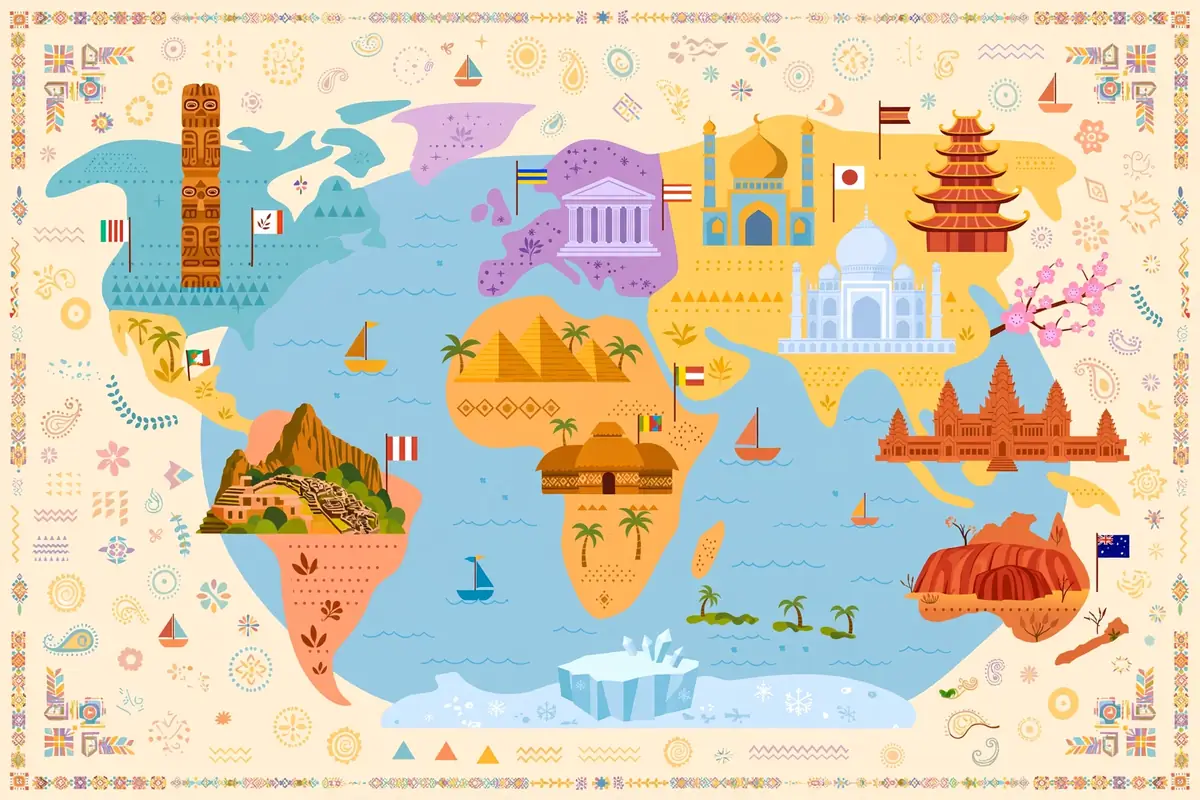
There are thousands of ethnic groups worldwide. Some of the largest include the Han Chinese (over a billion people), Arabs, Bengalis, and Punjabis. Others are small but culturally vibrant, like the Sami of northern Scandinavia, the Maori of New Zealand, or the Basques of Spain and France. In the United States, the census tracks detailed ethnic origins — German, Irish, English, Italian, Polish, French — alongside the Hispanic/Latino ethnic category, which itself contains dozens of national-origin subgroups (Mexican, Puerto Rican, Cuban, Dominican, and more).
African-American is itself a distinct ethnicity: forged from diverse African origins through the shared experience of slavery, segregation, and the civil rights struggle, with its own dialects, musical traditions, cuisine (soul food), and religious institutions. Jewish identity shows how ethnicity can transcend race and nationality: Jews worldwide share religious tradition, history, and often genetic markers, while spanning every racial category and holding many nationalities.
Why Ethnicity Matters
Ethnicity matters because it is central to identity for billions of people. It provides continuity with the past — a thread connecting you to ancestors you never met — and community in the present. It shapes what you eat, how you worship, whom you marry, and how you see yourself. Politically, ethnicity drives everything from census categories and affirmative action debates to independence movements and immigration policy. Understanding the concept helps you navigate a diverse world with more empathy and precision.
It also matters personally. Knowing your ethnicity — or exploring it, if you don’t yet know it — can be profoundly grounding. Genealogy is booming precisely because people crave the story of where they come from. Whether your heritage is singular or mixed, ancient or newly formed, it is part of what makes you you. And in an era of global migration, ethnic identity is increasingly fluid: third-generation immigrants blend traditions, intermarriage creates new combinations, and digital communities let diaspora members sustain culture across continents. Ethnicity, in short, is not a museum piece — it is a living, evolving part of human identity.
What Is an Ethnicity: Quick Reference
| Concept | Definition |
|---|---|
| Ethnicity | Shared cultural heritage: ancestry, language, religion, customs, history |
| Race | Socially defined categories based on physical traits |
| Nationality | Country of citizenship |
| Example | A person can be racially Asian, ethnically Korean, and nationally American — all at once |
| Key trait | Ethnicity is learned through culture; it can evolve and be embraced |
| Origin of word | Greek ethnos — nation, tribe, or people |
Frequently Asked Questions (FAQ)
What is an ethnicity in simple terms?
An ethnicity is a group of people who share a common culture — the same ancestral origins, language, traditions, religion, or history. Examples include Italians, Yoruba, Koreans, and Navajo. It’s about shared heritage, not just appearance.
What is the difference between ethnicity and race?
Race categorizes people by physical traits like skin color, while ethnicity describes shared cultural heritage like language and traditions. Two people of the same race can have different ethnicities (e.g., a Haitian and a Nigerian), and ethnicity is learned through culture rather than inherited biologically.
Can a person have more than one ethnicity?
Absolutely. Most people have multiple ethnic heritages — for example, someone with an Irish mother and a Nigerian father is both Irish and Nigerian ethnically. Mixed heritage is increasingly common worldwide, and many people actively embrace every thread of their background.
Is Hispanic an ethnicity or a race?
Hispanic/Latino is an ethnicity, not a race. It refers to people with cultural ties to Spanish-speaking Latin America or Spain. Hispanics can be of any race — white, Black, Indigenous, Asian, or mixed.
Is Jewish an ethnicity?
Yes — Jewish identity is both a religion and an ethnicity. Jews worldwide share common ancestry, history, traditions, and often genetic markers, spanning many races and nationalities. Many Jews identify as ethnically Jewish regardless of religious observance, and Jewish ethnic subdivisions like Ashkenazi, Sephardi, and Mizrahi reflect centuries of diaspora history across Europe, the Middle East, and North Africa.
For authoritative definitions, see Britannica on ethnicity and this sociology overview of race and ethnicity.
She holds advanced qualifications in Sociology, Anthropology, and Ethnic Studies, fields that focus on human cultures, traditions, migration patterns, and identity development across the world. Her expertise allows her to break down complex cultural topics into easy-to-understand articles that readers genuinely enjoy.
Over the years, Milana has researched hundreds of public figures, communities, and global ethnic groups, making her a trusted voice in the ethnicity niche. Her writing combines factual research, historical understanding, and modern cultural analysis to ensure every article is informative, reliable, and reader-friendly.
Her work focuses on:
* Ethnicity and ancestry research
* Cultural identity and heritage
* Nationality and family background
* Celebrity ethnicity breakdowns
* Global traditions and multicultural studies
Milana’s goal is to provide readers with authentic, well-researched, and trustworthy information while celebrating the diversity of cultures around the world. Through her detailed research and passion for cultural education, she continues to help audiences better understand ethnicity, heritage, and identity in today’s connected world.
- Larry Ellison Ethnicity: Jewish Mother and Italian Father - October 6, 2026
- Charlie Heaton Ethnicity: Nationality, Parents & Background - October 6, 2026
- Hilaria Baldwin Ethnicity: Heritage, Parents & Background Explained - October 6, 2026