Ethnicity vs Nationality: What’s the Difference? Explained


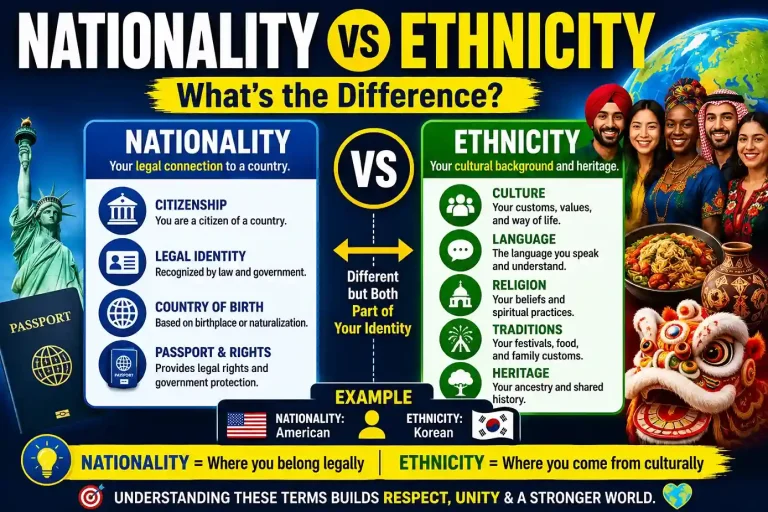
Ethnicity refers to a person’s cultural identity — shared ancestry, language, traditions, and heritage. Nationality refers to a person’s legal relationship with a country — their citizenship. In short: ethnicity is about who your people are, while nationality is about which country claims you as a citizen. The two often overlap, but they are not the same thing, and confusing them is one of the most common mistakes in discussions of identity.
Ethnicity: Definition and Meaning
An ethnicity (or ethnic group) is a population whose members identify with each other based on shared cultural traditions, common ancestry (real or presumed), language, religion, or group history. Ethnicity is inherited and cultural: you are born into an ethnic group through your family, and it connects you to a community that may span multiple countries. For example, Kurdish people share an ethnic identity while living across Turkey, Iraq, Syria, and Iran. Ethnicity can be expressed in hyphenated forms familiar in the United States — Irish-American, Korean-American, Mexican-American — where the first half names the ethnicity and the second half names the nationality. Ethnic identity often includes shared holidays, foods, customs, and sometimes physical traits, though no single marker defines every group. Importantly, ethnicity is about belonging and self-identification: if people believe they descend from a particular group and wish to be associated with it, they are generally considered members of it. This cultural dimension is what we explore in profiles like Rouba Saadeh, where heritage shapes identity across borders.
Nationality: Definition and Meaning
Nationality is the legal relationship between a person and a state. It determines citizenship: the passport you hold, the country that protects you abroad, and the civic rights and duties you bear (voting, taxation, military service, and so on). Nationality is typically acquired by birth within a country’s territory, by descent from citizen parents, or through naturalization. Unlike ethnicity, nationality is a political and legal status that can change — a person can hold dual nationality, renounce citizenship, or naturalize in a new country, but they cannot change their ethnic ancestry. A country like the United States contains hundreds of ethnic groups within a single nationality: American citizens may be ethnically Chinese, Nigerian, Italian, Mexican, or any combination. Conversely, members of one ethnic group — say, ethnic Turks — may hold German, French, or Turkish nationality. The family histories in Matt Danzeisen‘s profile illustrate how nationality and heritage can tell different stories about the same person.
Ethnicity vs Nationality: Key Differences
The core differences come down to five points. Basis: ethnicity is based on shared culture, ancestry, language, and traditions; nationality is based on legal citizenship in a nation-state. Changeability: ethnicity is inherited and essentially fixed; nationality can be changed through naturalization or renunciation. Scope: an ethnic group can span many countries (e.g., the Jewish diaspora, the Kurds); a nationality is tied to one specific state. Expression: ethnicity is expressed through culture — food, holidays, language; nationality is expressed through documents — passports, birth certificates. Multiplicity: a person has one or a blended ethnic heritage but may hold one, two, or more nationalities. Consider a concrete example: a person born in London to Nigerian parents who later naturalizes as a U.S. citizen is ethnically Nigerian (Yoruba, Igbo, etc.), and may hold British, American, or dual nationality — three different answers to “where are you from?” depending on which question is really being asked. For a fun related read, see our ethnicity guesser discussion.

Why the Distinction Matters
Mixing up ethnicity and nationality causes real-world confusion. On forms and surveys, “nationality” asks for your country of citizenship while “ethnicity” asks about your cultural background — answering one with the other produces bad data. In discussions of immigration and identity, the distinction clarifies debates: someone can be fully American in nationality while maintaining a distinct ethnic heritage, and hyphenated identities (Korean-American, Afro-Caribbean British) exist precisely because the two concepts are separate. The distinction also matters historically: ethnic nationalism — the 19th-century ideology of building nations around presumed shared ethnic origins, as in Germany or Italy — shaped modern Europe, while civic nationalism defines belonging by citizenship regardless of ethnicity, as in France or the United States. Understanding both terms helps explain everything from census categories to why DNA tests report “ethnicity estimates” rather than nationalities.
Real-World Examples That Make It Click
Abstract definitions land better with concrete cases. Take Zohran Mamdani: ethnically South Asian (Indian), born in Uganda, holding American nationality — three different answers depending on whether you ask about ethnicity, birthplace, or citizenship. Or Bruno Mars: ethnically mixed (Puerto Rican, Jewish, Filipino), born in Hawaii, American by nationality. Consider diaspora communities: an ethnically Armenian family might hold Lebanese, French, and American passports across three generations while remaining unmistakably Armenian in ethnicity — same people, three nationalities. The reverse happens too: a single nationality can contain staggering ethnic diversity. India, one country, is home to thousands of ethnic groups speaking hundreds of languages; “Indian” is a nationality, while Punjabi, Tamil, Bengali, and Gujarati are ethnicities. Switzerland’s four linguistic regions, Nigeria’s 250+ ethnic groups, and China’s 56 officially recognized ethnicities all illustrate the same principle: the borders of states and the boundaries of peoples rarely align. Even within families the terms diverge — children of immigrants often hold a different nationality from their parents’ birth country while carrying the same ethnicity, and naturalized citizens adopt new nationalities without shedding their ethnic heritage.
Ethnicity, Nationality, and Race: The Full Picture
To complete the picture, it helps to place a third term alongside the other two: race. If ethnicity is cultural identity and nationality is legal citizenship, race is a social categorization based primarily on perceived physical traits — skin color, facial features, hair texture. Like ethnicity, race is socially constructed rather than biologically precise, but it operates differently: race is typically assigned by how others perceive you, while ethnicity is claimed through culture and ancestry. A Black Brazilian and a Black Nigerian share a racial categorization but have entirely different ethnicities and nationalities. Meanwhile, two white Americans might share a race and nationality while belonging to different ethnic groups (say, Italian-American and Irish-American). The three concepts overlap and interact — discrimination often targets all three at once — but keeping them distinct allows for clearer thinking about identity. When someone asks “what are you?”, the most honest answer usually requires all three: I am racially Black, ethnically Jamaican, and American by nationality. Understanding the vocabulary does not just prevent confusion on forms and in conversation — it fosters respect for the layered, multifaceted nature of human identity in an interconnected world.
How to Talk About Ethnicity and Nationality Respectfully
Getting the vocabulary right is also a matter of respect. A few practical guidelines help. First, never assume: a person’s appearance does not reveal their ethnicity or nationality — ask, or better yet, let people self-identify. Second, use the terms precisely — describe someone’s citizenship as nationality and their cultural background as ethnicity, rather than blurring the two. Third, recognize hyphenated and layered identities as complete in themselves: “Mexican-American” is not half of each but a whole identity. Fourth, understand that for many people, ethnicity carries the weight of history — migration, struggle, and survival — and treating it as trivia can feel dismissive. Finally, remember that identities evolve: a naturalized citizen’s nationality changes, a person’s understanding of their own ethnicity can deepen over time, and children of mixed heritage may claim multiple ethnicities with pride. In professional and editorial contexts — including articles like those on this site — precision matters because readers use these profiles to understand real people. When we write that someone is “ethnically Korean and American by nationality,” we are honoring both halves of their story. Language shapes perception, and perceiving people accurately is the first step to respecting who they are.
Quick Facts
| Detail | Information |
|---|---|
| Ethnicity | Cultural identity: shared ancestry, language, traditions, heritage |
| Nationality | Legal identity: citizenship in a nation-state (passport country) |
| Can it change? | Ethnicity is inherited; nationality can change via naturalization |
| Scope | One ethnic group can span many countries; one nationality = one state |
| Example | Ethnically Kurdish person may hold Turkish, Iraqi, or German nationality |
| Hyphenated form | “Irish-American” = Irish ethnicity + American nationality |
Frequently Asked Questions
What is the difference between ethnicity and nationality?
Ethnicity is your cultural identity — shared ancestry, language, and traditions. Nationality is your legal citizenship — the country that issues your passport. Ethnicity is inherited; nationality can be changed.
Is American an ethnicity or nationality?
American is a nationality (U.S. citizenship). There is no single “American ethnicity” — Americans belong to hundreds of different ethnic groups.
Can you have more than one ethnicity or nationality?
Yes to both: you can have mixed ethnic heritage (e.g., a Korean and Mexican parent), and you can hold dual or multiple nationalities through birth, descent, or naturalization.
What is an example of ethnicity vs nationality?
A person born in Paris to Algerian parents who becomes a Canadian citizen is ethnically Algerian (Arab/Berber) and may hold French, Canadian, or dual nationality.
Why do forms ask for ethnicity and nationality separately?
Because they measure different things: nationality tracks legal citizenship for administrative purposes, while ethnicity tracks cultural background for demographic and diversity data.
Compare definitions at Diffen’s ethnicity vs nationality comparison and Wikipedia’s ethnic group article.
She holds advanced qualifications in Sociology, Anthropology, and Ethnic Studies, fields that focus on human cultures, traditions, migration patterns, and identity development across the world. Her expertise allows her to break down complex cultural topics into easy-to-understand articles that readers genuinely enjoy.
Over the years, Milana has researched hundreds of public figures, communities, and global ethnic groups, making her a trusted voice in the ethnicity niche. Her writing combines factual research, historical understanding, and modern cultural analysis to ensure every article is informative, reliable, and reader-friendly.
Her work focuses on:
* Ethnicity and ancestry research
* Cultural identity and heritage
* Nationality and family background
* Celebrity ethnicity breakdowns
* Global traditions and multicultural studies
Milana’s goal is to provide readers with authentic, well-researched, and trustworthy information while celebrating the diversity of cultures around the world. Through her detailed research and passion for cultural education, she continues to help audiences better understand ethnicity, heritage, and identity in today’s connected world.
- Larry Ellison Ethnicity: Jewish Mother and Italian Father - October 6, 2026
- Charlie Heaton Ethnicity: Nationality, Parents & Background - October 6, 2026
- Hilaria Baldwin Ethnicity: Heritage, Parents & Background Explained - October 6, 2026