The Future of Artificial Intelligence: Latest AI Developments, Trends, and Innovations in 2026

Introduction
Artificial Intelligence (AI) has evolved from a promising technology into one of the most transformative forces shaping the modern world. What began as simple machine-learning systems has now become a sophisticated ecosystem of intelligent agents, multimodal models, autonomous software systems, and advanced reasoning engines capable of solving increasingly complex problems.
In 2026, AI is no longer limited to generating text or answering questions. The latest generation of AI systems can analyze images, understand videos, process audio, write software, automate business operations, assist doctors, improve manufacturing processes, and even collaborate with humans on scientific research.
Businesses, governments, educational institutions, and individuals are rapidly adopting AI technologies to increase productivity, reduce costs, and unlock entirely new opportunities. As a result, AI has become one of the most important technological revolutions since the invention of the internet.
This article explores the latest AI developments in 2026, emerging trends, major breakthroughs, challenges, and what the future may hold for artificial intelligence.
What Is Artificial Intelligence?
Artificial Intelligence refers to computer systems designed to perform tasks that traditionally require human intelligence.
These tasks include:
- Learning from data
- Problem-solving
- Decision-making
- Language understanding
- Visual recognition
- Pattern detection
- Reasoning
- Planning
- Automation
Modern AI systems use advanced neural networks and large-scale training datasets to learn patterns and generate intelligent outputs.
How AI Has Evolved
The AI industry has experienced several major phases:
Rule-Based AI
Early AI systems followed predefined rules and could only perform specific tasks.
Machine Learning
Machine learning enabled computers to learn patterns from data rather than relying entirely on programmed instructions.
Deep Learning
Deep learning introduced neural networks capable of handling vast amounts of information and recognizing complex patterns.
Generative AI
Generative AI revolutionized the industry by enabling systems to create:
- Text
- Images
- Audio
- Video
- Software code
Agentic AI
The newest evolution is Agentic AI, where systems can autonomously perform tasks, make decisions, use tools, and accomplish goals with minimal human intervention. Researchers and industry leaders increasingly view agent-based systems as the next stage of AI development.
The Biggest AI Trends in 2026
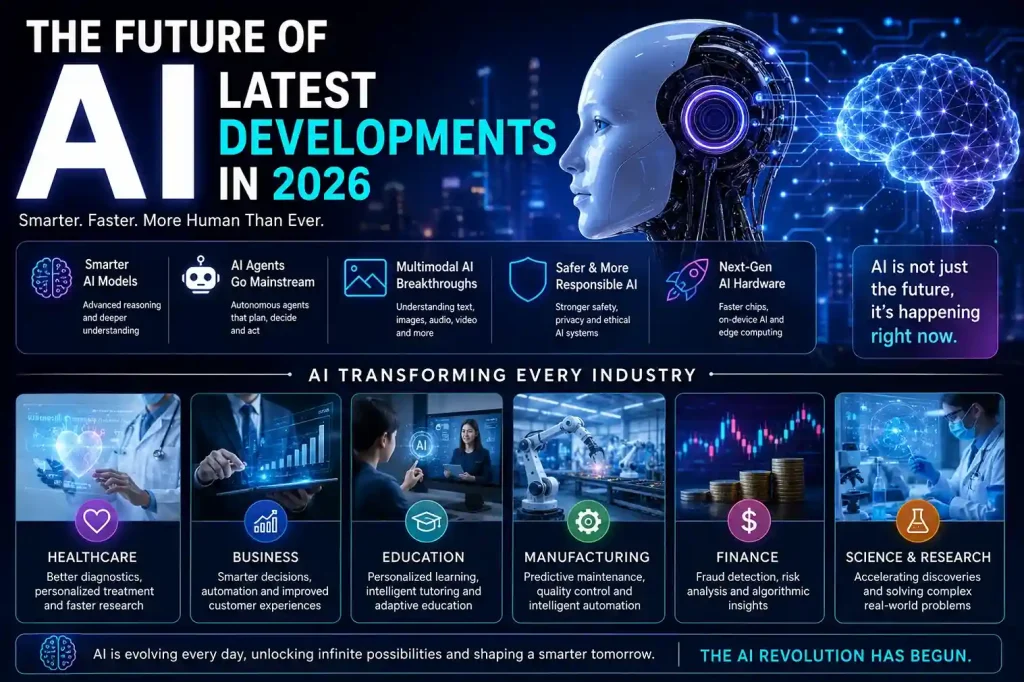
1. AI Agents Are Becoming Mainstream
One of the most significant developments in 2026 is the rise of AI agents.
Unlike traditional chatbots, AI agents can:
- Plan tasks
- Use software tools
- Access databases
- Execute workflows
- Collaborate with other agents
- Complete multi-step objectives
Instead of simply answering questions, AI agents can perform meaningful work on behalf of users.
Businesses are increasingly deploying AI agents for:
- Customer support
- Software development
- Marketing automation
- Data analysis
- Human resources
- Financial operations
Experts consider agentic AI one of the defining technology shifts of the decade.
2. Multimodal AI Is Changing Human-Computer Interaction
Modern AI systems are no longer limited to text.
Multimodal AI can process:
- Text
- Images
- Video
- Audio
- Voice
- Documents
This allows AI to understand information much more like humans do.
For example, modern AI systems can:
- Analyze medical scans
- Understand screenshots
- Interpret diagrams
- Process voice commands
- Generate videos
- Describe images
Multimodal AI is becoming essential in healthcare, retail, finance, manufacturing, and education.
3. Advanced Reasoning Models
AI models are becoming significantly better at reasoning.
Earlier models focused primarily on pattern prediction.
Modern reasoning models can:
- Break down complex problems
- Plan multiple steps ahead
- Verify solutions
- Solve advanced mathematical challenges
- Write sophisticated software
Recent AI developments show increasing investment in reasoning-focused models designed for coding, engineering, and enterprise applications.
4. AI-Powered Software Development
Software engineering is experiencing a major transformation.
AI coding assistants can now:
- Generate code
- Detect bugs
- Write documentation
- Optimize software
- Suggest improvements
- Review pull requests
Many development teams now use AI as a collaborative partner rather than a simple tool.
The next generation of AI coding systems can manage large software projects and coordinate changes across multiple files automatically.
5. AI Devices and Agent-First Computing
The traditional app-based computing model is beginning to evolve.
Major technology companies are investing in AI-first devices where intelligent agents become the primary interface.
Rather than opening multiple apps, users can simply describe a goal and allow AI agents to complete the task.
This shift is driving the development of:
- AI operating systems
- AI wearables
- AI desktops
- AI-powered personal assistants
Several major technology companies unveiled agent-focused computing initiatives during 2026, signaling a broader transition toward AI-native experiences.
AI in Healthcare
Healthcare remains one of the most promising sectors for AI adoption.
AI applications include:
Medical Imaging
AI systems can analyze:
- X-rays
- MRIs
- CT scans
- Ultrasounds
with remarkable speed and accuracy.
Drug Discovery
AI accelerates pharmaceutical research by identifying promising compounds faster than traditional methods.
Personalized Medicine
AI helps doctors create treatment plans tailored to individual patients.
Clinical Decision Support
Healthcare professionals increasingly use AI to assist with diagnoses and treatment recommendations.
AI is expected to play a major role in improving patient outcomes over the next decade.
AI in Business
Businesses are investing billions in AI technologies.
Key applications include:
Customer Service
AI chatbots and agents provide 24/7 support.
Marketing
AI helps create:
- Content
- Advertisements
- Email campaigns
- SEO strategies
Data Analytics
Organizations use AI to identify trends and make informed decisions.
Process Automation
AI reduces repetitive manual work and improves efficiency.
Human Resources
AI assists with recruiting, candidate screening, and employee support.
Companies that effectively adopt AI are gaining significant competitive advantages.
AI in Education
Artificial Intelligence is reshaping education worldwide.
Students now benefit from:
- Personalized learning paths
- Intelligent tutoring systems
- Automated assessments
- Real-time feedback
- Interactive educational experiences
Teachers can focus more on instruction while AI handles administrative tasks.
Educational institutions increasingly use AI to improve learning outcomes and student engagement.
AI and Scientific Research
One of the most exciting developments is AI’s role in scientific discovery.
Researchers are deploying AI systems to:
- Analyze massive datasets
- Design experiments
- Discover new materials
- Model climate systems
- Study genetics
- Explore particle physics
Some experts believe AI agents could fundamentally transform how scientific research is conducted in the coming decades.
Challenges Facing Artificial Intelligence
Despite its incredible potential, AI also presents significant challenges.
Bias and Fairness
AI systems may inherit biases from training data.
Privacy Concerns
Organizations must carefully protect user information.
Security Risks
Advanced AI systems could be exploited by cybercriminals.
Misinformation
AI-generated content can sometimes spread inaccurate information.
Job Displacement
Automation may impact certain professions and industries.
Regulation
Governments worldwide are developing policies to ensure responsible AI deployment.
Addressing these concerns will be essential for sustainable AI growth.
The Rise of Small and Efficient AI Models
While giant AI models receive significant attention, smaller models are becoming increasingly important.
Advantages include:
- Lower operating costs
- Faster performance
- Improved privacy
- Local device execution
- Reduced energy consumption
Many experts believe future AI ecosystems will combine both large cloud-based models and efficient local models.
The Future of AI Agents
AI agents represent one of the most important trends of the next decade.
Future agents may:
- Manage schedules
- Handle finances
- Book travel
- Conduct research
- Run businesses
- Coordinate teams
- Automate workflows
Rather than interacting with dozens of separate applications, users may increasingly rely on intelligent agents that understand goals and execute tasks automatically.
What Will AI Look Like in 2030?
By 2030, AI may become deeply integrated into everyday life.
Potential developments include:
- Fully autonomous digital assistants
- AI-powered healthcare diagnostics
- Intelligent transportation systems
- Advanced robotics
- Real-time language translation
- Personalized education platforms
- Scientific discovery acceleration
- Smart city infrastructure
While predicting the future is difficult, most experts agree that AI will continue transforming nearly every industry.
Conclusion
Artificial Intelligence has entered a new era. The focus is no longer solely on generating text or answering questions. The latest AI developments in 2026 revolve around intelligent agents, multimodal understanding, advanced reasoning, automation, and real-world problem solving.
Businesses are using AI to improve productivity. Researchers are leveraging AI to accelerate scientific discoveries. Healthcare providers are enhancing patient care through intelligent diagnostics. Developers are building software faster than ever before.
As AI continues to evolve, organizations and individuals who understand and embrace these technologies will be best positioned to succeed in an increasingly AI-driven world.
The future of AI is not a distant possibility—it is already unfolding today.
Frequently Asked Questions
What is the biggest AI trend in 2026?
AI agents capable of autonomous task execution are considered one of the biggest trends.
What is multimodal AI?
Multimodal AI can process multiple types of data, including text, images, audio, and video.
Will AI replace human jobs?
AI will automate some tasks but is also expected to create new opportunities and industries.
Which industries benefit most from AI?
Healthcare, finance, education, manufacturing, logistics, retail, and software development are among the biggest beneficiaries.
What is Agentic AI?
Agentic AI refers to AI systems that can plan, reason, make decisions, and complete tasks with minimal human supervision.

- Brumeblog.com Review (2026): Is It Legit, Safe & Worth Reading? Complete Expert Analysis - July 14, 2026
- Glossywise Com Review (2026): Is It Legit, Safe, and Worth Reading? - July 14, 2026
- Do the Driving Modes in Cadillac Lyriq Offer Different Ranges or Battery Usage? Complete Expert Guide (2026) - July 14, 2026