Nationality vs Ethnicity: What’s the Difference?

Introduction
Many people use the terms “nationality” and “ethnicity” interchangeably, but they actually describe different parts of a person’s identity. Understanding the difference between nationality and ethnicity is important because these concepts influence culture, citizenship, heritage, and social identity across the world.
In multicultural societies like the United States, Canada, and the United Kingdom, people often share the same nationality while belonging to completely different ethnic backgrounds. This is why questions such as:
- “What is your nationality?”
- “What is your ethnicity?”
can have very different answers.
For example:Understand the difference between nationality and ethnicity with simple explanations, examples, and comparison tables.
- Someone may be American by nationality
- But Mexican, Korean, Nigerian, or Arab by ethnicity
This guide explains nationality vs ethnicity in simple words while covering definitions, examples, comparison tables, common myths, and real-life situations.
By the end of this article, you will clearly understand:
- What nationality means
- What ethnicity means
- The difference between nationality and ethnicity
- How race connects to both concepts
- Real-world examples from different countries
🌍 Nationality vs Ethnicity
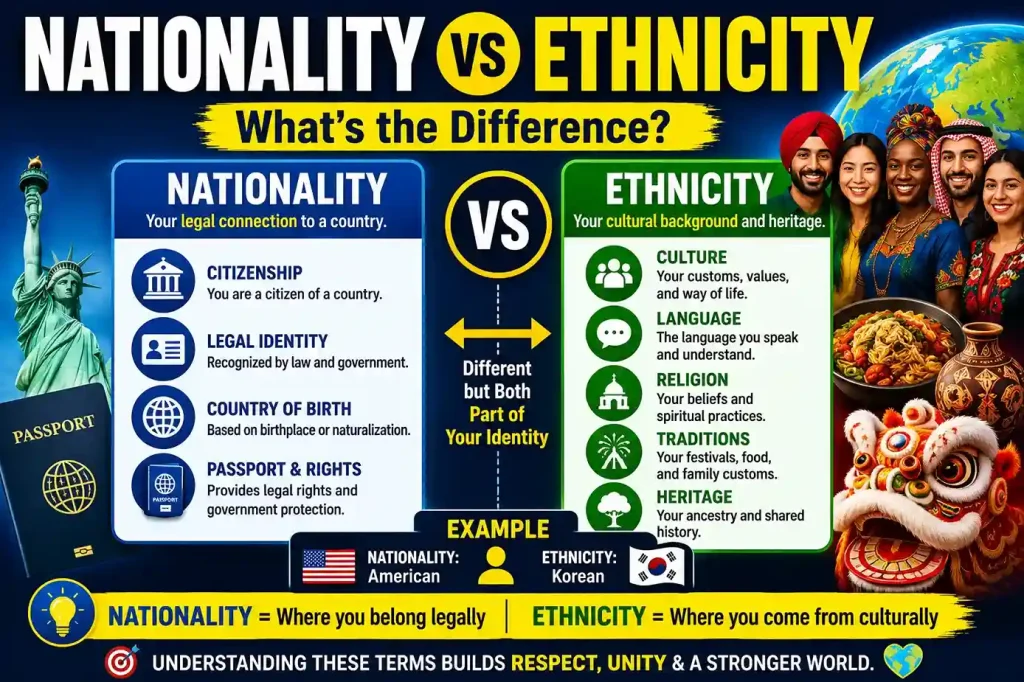
Many people confuse nationality and ethnicity, but they describe different parts of identity. Nationality refers to legal citizenship and country membership, while ethnicity focuses on culture, ancestry, traditions, and heritage.
🛂 What Is Nationality?
Nationality means official legal citizenship connected to a country such as American, British, Canadian, or Australian.
🌐 What Is Ethnicity?
Ethnicity refers to shared culture, language, traditions, religion, ancestry, and family heritage.
⚖ Main Difference
Nationality is connected to government and citizenship, while ethnicity is connected to culture and ancestry.
👨👩👧 Multicultural Identity
A person can share nationality with others while having completely different ethnic backgrounds and traditions.
📌 Simple Example
A person may be American by nationality, but Mexican, Korean, Arab, or Punjabi by ethnicity.
What Is Nationality?
Nationality refers to a person’s legal relationship with a country.
It usually means:
- Citizenship
- Official membership in a nation
- Legal identity recognized by a government
Nationality is connected to the country where a person:
- Was born
- Holds citizenship
- Has legal rights and responsibilities
Examples of nationality include:
- American
- Canadian
- British
- Australian
- Indian
- Japanese
A person’s nationality is often shown through official documents such as:
- Passports
- National ID cards
- Citizenship certificates
What Is Ethnicity?
Ethnicity refers to a person’s cultural identity, heritage, ancestry, traditions, and shared historical background.
Unlike nationality, ethnicity focuses more on:
- Culture
- Language
- Religion
- Traditions
- Family heritage
- Shared ancestry
Examples of ethnicity include:
- Italian
- Punjabi
- Arab
- Korean
- Yoruba
- Mexican
Ethnicity often influences:
- Family customs
- Food traditions
- Cultural celebrations
- Music and art
- Religious practices
Nationality vs Ethnicity: Main Difference
The main difference between nationality and ethnicity is:
| Nationality | Ethnicity |
|---|---|
| Legal connection to a country | Cultural heritage and identity |
| Based on citizenship | Based on ancestry and traditions |
| Can change legally | Usually connected to family roots |
| Example: American | Example: Mexican |
Nationality focuses on legal identity, while ethnicity focuses on cultural background and heritage.
Ethnicity vs Nationality Explained in Simple Words
In simple words:
👉 Nationality = the country you legally belong to
👉 Ethnicity = the cultural group your family comes from
For example:
A person may be:
- Canadian by nationality
- Punjabi by ethnicity
Another person may be:
- American by nationality
- Korean by ethnicity
This shows that nationality and ethnicity are connected but not identical.
Definition of Nationality
The definition of nationality is:
A legal relationship between a person and a country, usually based on citizenship or birth.
Nationality gives people legal rights such as:
- Voting rights
- Government protection
- Travel documentation
- Access to public services
Definition of Ethnicity
The definition of ethnicity is:
A cultural identity shared by a group of people connected through ancestry, language, traditions, religion, or heritage.
Ethnicity helps preserve cultural traditions across generations.
Key Characteristics of Nationality
Nationality has several important legal and political characteristics.
Citizenship
Citizenship is one of the strongest indicators of nationality.
Citizens usually receive:
- Legal rights
- National protection
- Access to government services
Legal Identity
Nationality gives people official recognition under a country’s laws.
This legal identity affects:
- Immigration status
- Voting eligibility
- National rights
Country of Birth
In many countries, people automatically receive nationality based on birthplace.
However, nationality laws vary globally.
Passport & Government Recognition
Passports are official proof of nationality.
Governments use nationality to identify citizens internationally.
Key Characteristics of Ethnicity
Ethnicity focuses more on culture and shared heritage.
Culture
Culture includes:
- Food
- Clothing
- Music
- Social values
- Daily customs
Different ethnic groups maintain unique cultural traditions.
Language
Language often plays a major role in ethnic identity.
Examples include:
- Arabic-speaking communities
- Spanish-speaking Latino groups
- Punjabi-speaking families
Traditions
Ethnic traditions may involve:
- Weddings
- Festivals
- Family gatherings
- Religious ceremonies
These traditions help preserve identity across generations.
Religion
Some ethnic groups strongly connect with certain religions.
Examples include:
- Jewish communities
- Sikh Punjabi communities
- Arab Muslim communities
Shared Heritage
Heritage refers to ancestry and family roots passed through generations.
Many people identify strongly with their ethnic heritage even after living in another country for decades.
Nationality vs Ethnicity Comparison Table
| Feature | Nationality | Ethnicity |
|---|---|---|
| Focus | Legal citizenship | Cultural identity |
| Based On | Country membership | Heritage & ancestry |
| Can Change? | Yes legally | Usually remains connected to ancestry |
| Examples | American, British | Italian, Arab |
| Connected To | Government & law | Culture & traditions |
Real-Life Examples of Nationality and Ethnicity
Here are some real-world examples:
| Nationality | Ethnicity |
|---|---|
| American | Mexican-American |
| British | Pakistani |
| Canadian | Chinese |
| Australian | Greek |
| French | Arab |
These examples show that people may share nationality while having different ethnic backgrounds.
Can Two People Have the Same Nationality but Different Ethnicities?
Yes.
For example:
Two people may both be:
- American by nationality
But one person may identify as:
- Korean-American
while another may identify as:
- African-American
Their nationality is the same, but their ethnic heritage differs.
Can Someone Have Multiple Ethnicities?
Absolutely.
Many people today come from multicultural families and identify with multiple ethnic backgrounds.
Examples include:
- Filipino-Irish
- Mexican-Italian
- Chinese-Canadian
- African-Caribbean
Global migration and multicultural societies have made mixed ethnic identities increasingly common.
Can Nationality Change?
Yes.
Nationality can change legally through processes such as:
- Immigration
- Naturalization
- Dual citizenship
For example:
A person born in India may later become:
- American by nationality
However, their ethnic background may still remain Punjabi, Tamil, or Gujarati.
Why People Confuse Nationality and Ethnicity
People often confuse nationality and ethnicity because:
- Both relate to identity
- Both may appear on official forms
- Countries can contain many ethnic groups
- Media sometimes uses the terms incorrectly
However, nationality focuses on legal identity, while ethnicity focuses on cultural heritage.
Nationality, Race, and Ethnicity Explained Together
These three concepts describe different aspects of identity.
| Term | Meaning |
|---|---|
| Nationality | Legal citizenship |
| Race | Physical or social classification |
| Ethnicity | Cultural heritage |
For example:
A person may be:
- Black by race
- Nigerian by ethnicity
- British by nationality
Another example:
- Asian by race
- Korean by ethnicity
- American by nationality
Nationality vs Race vs Ethnicity
| Feature | Nationality | Race | Ethnicity |
|---|---|---|---|
| Based On | Citizenship | Physical appearance | Culture & ancestry |
| Examples | Canadian | Asian | Japanese |
| Can Change? | Yes | Rarely | Sometimes culturally |
This comparison helps explain why these terms are related but distinct.
Importance of Understanding Nationality and Ethnicity
Understanding these concepts helps promote:
- Cultural awareness
- Diversity and inclusion
- Respect between communities
- Better communication in multicultural societies
It also reduces stereotypes and confusion around identity.
Nationality and Ethnicity in Official Forms
Many official forms ask about nationality and ethnicity separately.
Examples include:
- Census surveys
- Immigration documents
- School applications
- Healthcare records
Governments and researchers use this information to better understand population diversity and community needs.
Common Misunderstandings About Ethnicity and Nationality
Myth: Nationality and ethnicity are the same
Reality: Nationality refers to citizenship, while ethnicity refers to cultural heritage.
Myth: A country has only one ethnicity
Reality: Most countries contain many ethnic groups.
Myth: Ethnicity can always be identified by appearance
Reality: Ethnicity is mainly cultural, not purely physical.
Myth: Nationality never changes
Reality: Nationality can change through citizenship or immigration processes.
Frequently Asked Questions (FAQs)
What is the difference between nationality and ethnicity?
Nationality refers to legal citizenship, while ethnicity refers to cultural background, ancestry, and heritage.
Is nationality the same as ethnicity?
No. Nationality relates to country membership, while ethnicity relates to cultural identity.
Can a person change nationality?
Yes. People can change nationality through immigration, citizenship, or naturalization.
Can two people have the same nationality but different ethnicities?
Yes. Many countries contain people from multiple ethnic backgrounds.
What are examples of nationality and ethnicity?
Someone may be American by nationality and Korean by ethnicity.
Final Thoughts
Nationality and ethnicity are closely connected concepts, but they describe different parts of identity.
- Nationality focuses on legal citizenship and country membership.
- Ethnicity focuses on culture, ancestry, traditions, and heritage.
Understanding the difference between nationality and ethnicity helps create stronger cultural awareness and respect in increasingly diverse societies around the world.
As globalization continues connecting people from different backgrounds, understanding these concepts becomes more important than ever for education, communication, and social understanding.
She holds advanced qualifications in Sociology, Anthropology, and Ethnic Studies, fields that focus on human cultures, traditions, migration patterns, and identity development across the world. Her expertise allows her to break down complex cultural topics into easy-to-understand articles that readers genuinely enjoy.
Over the years, Milana has researched hundreds of public figures, communities, and global ethnic groups, making her a trusted voice in the ethnicity niche. Her writing combines factual research, historical understanding, and modern cultural analysis to ensure every article is informative, reliable, and reader-friendly.
Her work focuses on:
* Ethnicity and ancestry research
* Cultural identity and heritage
* Nationality and family background
* Celebrity ethnicity breakdowns
* Global traditions and multicultural studies
Milana’s goal is to provide readers with authentic, well-researched, and trustworthy information while celebrating the diversity of cultures around the world. Through her detailed research and passion for cultural education, she continues to help audiences better understand ethnicity, heritage, and identity in today’s connected world.
- Turnkey Properties Explained: What Buyers Need to Know - September 22, 2026
- Howard Schultz and George Soros: What Is Their Connection? - September 22, 2026
- George Soros and Barack Obama: Their Political Connection Explained - September 22, 2026