Kimora Lee Simmons Ethnicity: Her Japanese, Korean, and African-American Roots Explained


Kimora Lee Simmons is of mixed ethnicity — African-American on her father’s side and Japanese and Korean on her mother’s side. Born Kimora Lee Perkins on May 4, 1975, in St. Louis, Missouri, the fashion designer, former model, and creator of the Baby Phat empire is the daughter of Vernon Whitlock Jr., an African-American man who worked as a federal marshal, EEOC investigator, and bail bondsman, and Joanne Perkins, a woman born in Japan with Korean roots who was adopted by an American family during the Korean War. Her striking multiethnic heritage — half Black, one-quarter Japanese, one-quarter Korean — made her stand out in the fashion world of the late 1980s and became the foundation of a career built on celebrating mixed identity.
Discovered at 13 and signed to an exclusive contract with Chanel at 14, Kimora became one of Karl Lagerfeld’s muses — one of his “Karlettes” — at a time when mixed-race models were still a rarity on Parisian runways. She has often credited her mother with seeing potential in the very features school bullies mocked, enrolling her in modeling classes at age 11 and setting her on the path to becoming one of fashion’s most successful multiethnic moguls.
This guide explores Kimora Lee Simmons’ ethnicity in full: her mother’s Japanese-Korean story, her father’s African-American roots, and how her heritage shaped the Baby Phat phenomenon.
Quick Facts: Kimora Lee Simmons
| Detail | Fact |
|---|---|
| Full Name | Kimora Lee Simmons (née Perkins) |
| Date of Birth | May 4, 1975 |
| Birthplace | St. Louis, Missouri, USA |
| Nationality | American |
| Ethnicity | African-American (father); Japanese and Korean (mother) |
| Profession | Fashion designer, model, television personality, businesswoman |
Early Life and Background
Kimora Lee Perkins was born in St. Louis, Missouri, and raised in its northern suburbs. Her childhood was difficult: exceptionally tall from a young age — 5’10” by age 10, eventually reaching 6 feet — and visibly of mixed ancestry in a community with few families like hers, she was teased and bullied by schoolmates, who cruelly nicknamed her the “chinky giraffe.” Her parents separated, and she was raised primarily by her mother.
Her mother, Joanne, saw what the bullies couldn’t. At age 11, she enrolled Kimora in a modeling class to build her confidence. Two years later, at a model search in Kansas City, Kimora was discovered by an agent for Paris agency Glamour and sent to France. At 14, she signed an exclusive modeling contract with Chanel, becoming the protégée — and closing model for the 1989 haute couture show — of Karl Lagerfeld himself. Contracts with Valentino and Yves Saint Laurent followed, along with covers of Vogue and Elle across Europe and Asia.
She graduated from Lutheran North High School in St. Louis, and her modeling success soon translated into business. After marrying Def Jam co-founder Russell Simmons in 1998, she took creative control of his Phat Farm’s women’s offshoot and built Baby Phat — launched in 1999 — into a global lifestyle brand spanning denim, handbags, accessories, fragrance, and children’s apparel. She later starred in the reality series Kimora: Life in the Fab Lane (2007–2011), published the lifestyle book Fabulosity (2006), and served as president and creative director of JustFab.
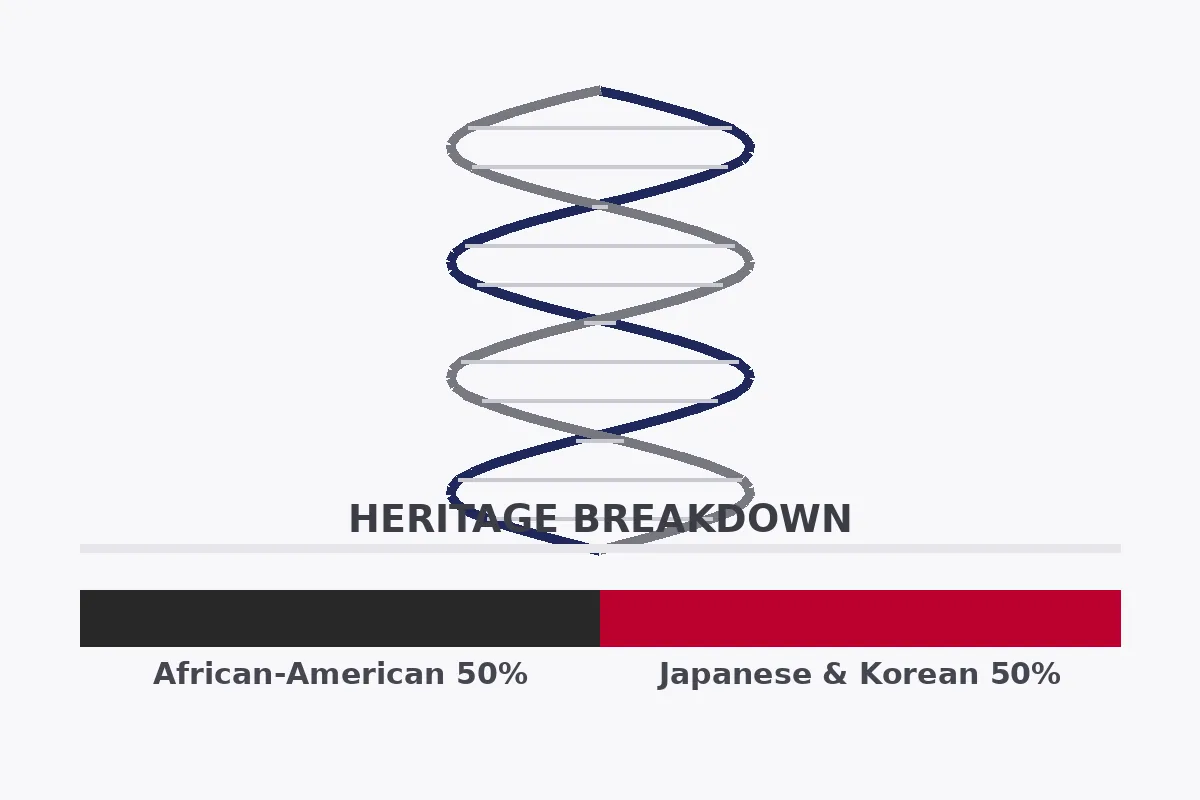
Kimora Lee Simmons’ Ethnicity: African-American Father, Japanese-Korean Mother
Kimora Lee Simmons’ ethnicity reflects three distinct heritages. Her father, Vernon Whitlock Jr., was African-American — a man who worked across an unusually varied career as an Equal Employment Opportunity Commission investigator, a bail bondsman, a federal marshal (reportedly among the first Black deputy federal marshals in St. Louis), and later a barber. Her mother, Joanne Perkins (also known as Joanne Kyoko Syng), was born in Japan with Korean roots and was adopted by an American serviceman’s family during the Korean War, growing up in the United States before becoming a Social Security administrator.
The result: Kimora is half African-American, one-quarter Japanese, and one-quarter Korean — a combination vanishingly rare in American public life when she emerged in the late 1980s. She has spoken frankly about the double-edged nature of that visibility. As she told Vibe: “Being a model of mixed ancestry may be fun and hot and hip and cool today, but years ago, there were a lot of casting agents and brands that didn’t know what to do with me.” The industry, she explained, had no category for her — which ultimately became her advantage, as designers like Lagerfeld recognized that her “otherness” was precisely what made her unforgettable.
Her mother’s story is itself a remarkable thread of 20th-century history: a child of Japanese birth and Korean blood, displaced by the Korean War, adopted into an American military family, and raised in the United States — who then raised a daughter straddling Black and Asian America in 1970s Missouri. Kimora has described her mother’s quiet elegance and poise as the source of her own runway confidence, and the family’s multicultural reality as the wellspring of the inclusive vision behind Baby Phat, a brand explicitly marketed to “women of various ethnicities, sizes, and walks of life.”
That inclusivity was radical for its time. In the late 1990s and 2000s, mainstream fashion still centered a narrow ideal; Baby Phat’s celebration of curvy, multiethnic, hip-hop-inflected femininity — with Kimora herself, all six feet of Japanese-Korean-Black fabulosity, as its embodiment — helped crack that ideal open. For more stories of multiethnic fashion and entertainment figures, see our profiles of Korina Harrison and Kirsten Barlow.
Family and Personal Life
Kimora married Russell Simmons in 1998 on the island of St. Barth’s, in a ceremony officiated by his brother, Rev. Run of Run-DMC. They had two daughters, Ming Lee (born 2000) and Aoki Lee (born 2002), before divorcing in 2009. She was subsequently in a long-term relationship with actor Djimon Hounsou (2007–2012), with whom she has a son, Kenzo Lee (born 2009). In 2014 she married investment banker Tim Leissner; they had a son, Wolfe, and adopted a son, Gary (2021), before separating in 2022.
Her five children carry forward an extraordinary multiethnic legacy: African-American, Japanese, and Korean heritage from their mother, blended with their fathers’ own diverse backgrounds — including Beninese (Hounsou) roots for Kenzo. Kimora has raised her family in the public eye while keeping their cultural education a visible priority, frequently sharing celebrations that honor all sides of their heritage.
Her relationship with her own parents remained complex — her father served prison time during her childhood, and she was raised by her mother — but she has consistently credited both with shaping her: her father’s resilience and work ethic, her mother’s grace and multicultural poise. For the documented details of her biography, see Kimora Lee Simmons’ Wikipedia biography and this TV Insider profile of Kimora Lee Simmons.

Legacy: Fabulosity as Heritage
Kimora Lee Simmons turned the very things she was bullied for — her height, her “exotic” mixed features — into the foundation of a fashion empire. Baby Phat, at its peak, was a cultural phenomenon: the cat logo, the velour tracksuits, the unapologetic glamour, all broadcasting a message that beauty comes in every blend. She was doing “representation matters” as a business strategy a decade before it became an industry slogan.
Her 2006 book Fabulosity: What It Is and How to Get It distilled her philosophy — confidence as a practice, heritage as an asset — for a generation of young women. And her continued presence in fashion and media, including the 2025 series Kimora: Back in the Fab Lane, keeps her multiethnic story in front of new audiences. From a bullied mixed-race girl in St. Louis to a mogul who dressed a movement, Kimora Lee Simmons’ ethnicity isn’t just a biographical detail — it’s the engine of everything she built.
Business Empire Beyond Baby Phat
While Baby Phat remains her signature achievement, Kimora Lee Simmons built a diversified business empire that reflected her multicultural vision. After the brand’s sale to Kellwood for a reported $140 million in 2004, she continued as its president and creative director through 2010, then took the helm of the personalized shopping service JustFab (now TechStyle) as president and creative director in 2011. Her fragrance lines — including Baby Phat Goddess (2005) — extended the brand into beauty, while her 2006 book Fabulosity codified her philosophy of confidence as a lifestyle.
Her reality television career — Kimora: Life in the Fab Lane (2007–2011), Kimora: House of Fab (2013), and Kimora: Back in the Fab Lane (2025) — kept her multiethnic family and unapologetic glamour in front of audiences for nearly two decades. A Tony Award as a producer of Broadway’s Def Poetry Jam in 2003 added theatrical prestige to a résumé that already spanned modeling, design, publishing, and television.
Through every venture runs the same thread: the St. Louis girl once mocked as the “chinky giraffe” built businesses celebrating exactly what made her different. Her Japanese-Korean-African-American heritage wasn’t a footnote to her success — it was the brand.
Frequently Asked Questions (FAQ)
What is Kimora Lee Simmons’ ethnicity?
Kimora Lee Simmons is of mixed ethnicity: African-American on her father’s side and Japanese and Korean on her mother’s side — roughly half Black, one-quarter Japanese, and one-quarter Korean.
Who are Kimora Lee Simmons’ parents?
Her father was Vernon Whitlock Jr., an African-American federal marshal, EEOC investigator, and bail bondsman. Her mother is Joanne Perkins, born in Japan with Korean roots and adopted by an American family during the Korean War.
Is Kimora Lee Simmons Japanese or Korean?
Both, through her mother: Joanne Perkins was born in Japan and is of Korean descent, making Kimora one-quarter Japanese and one-quarter Korean.
How did Kimora Lee Simmons become famous?
Discovered at a Kansas City model search at age 13, she signed an exclusive Chanel contract at 14 and became Karl Lagerfeld’s muse. She later built the Baby Phat fashion empire (launched 1999) and starred in reality TV.
Where was Kimora Lee Simmons born?
Kimora Lee Perkins was born on May 4, 1975, in St. Louis, Missouri, USA, where she was raised in the city’s northern suburbs.
She holds advanced qualifications in Sociology, Anthropology, and Ethnic Studies, fields that focus on human cultures, traditions, migration patterns, and identity development across the world. Her expertise allows her to break down complex cultural topics into easy-to-understand articles that readers genuinely enjoy.
Over the years, Milana has researched hundreds of public figures, communities, and global ethnic groups, making her a trusted voice in the ethnicity niche. Her writing combines factual research, historical understanding, and modern cultural analysis to ensure every article is informative, reliable, and reader-friendly.
Her work focuses on:
* Ethnicity and ancestry research
* Cultural identity and heritage
* Nationality and family background
* Celebrity ethnicity breakdowns
* Global traditions and multicultural studies
Milana’s goal is to provide readers with authentic, well-researched, and trustworthy information while celebrating the diversity of cultures around the world. Through her detailed research and passion for cultural education, she continues to help audiences better understand ethnicity, heritage, and identity in today’s connected world.
- Larry Ellison Ethnicity: Jewish Mother and Italian Father - October 6, 2026
- Charlie Heaton Ethnicity: Nationality, Parents & Background - October 6, 2026
- Hilaria Baldwin Ethnicity: Heritage, Parents & Background Explained - October 6, 2026