Memory Foam vs Hybrid Mattresses: Comparison Table, Pros, Cons, and Which Is Better?

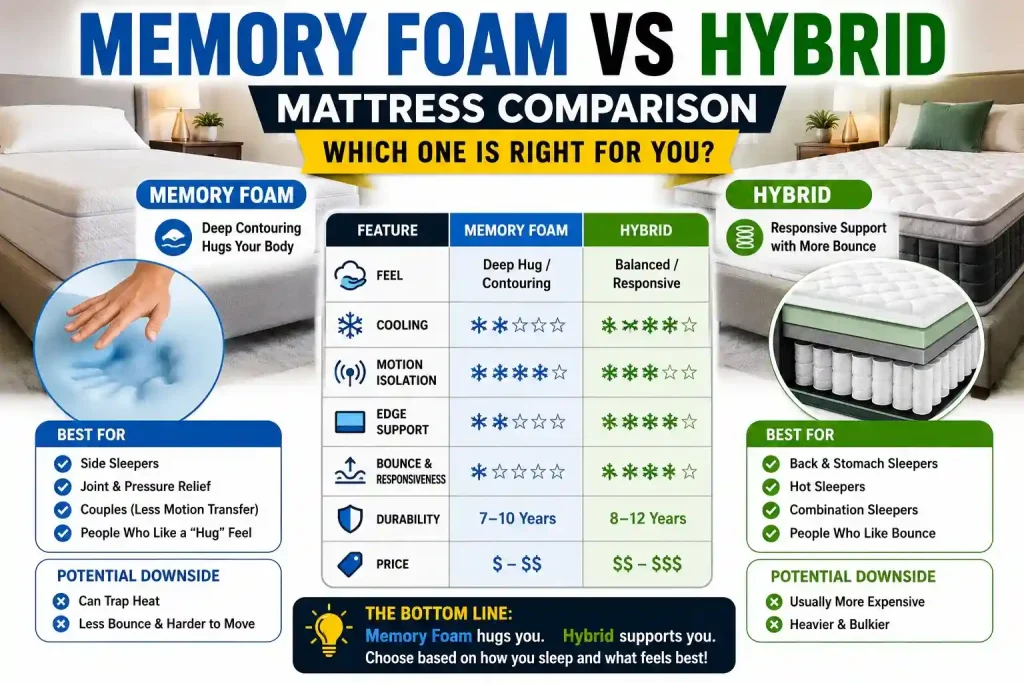
Choosing between a memory foam and hybrid mattress can be surprisingly difficult. Both can provide pressure relief and comfortable support, but they feel very different at night.
Memory foam is known for its contouring, quiet surface, and strong motion isolation. Hybrid mattresses combine foam or latex comfort layers with a coil support system, giving them more bounce, airflow, and edge support. (Sleep Foundation)
So, which is better: memory foam or hybrid?
There is no universal winner. The better choice depends on how you sleep, how much you move, whether you sleep hot, your preferred firmness, and how much support you need.
Memory Foam vs Hybrid Mattress: Quick Comparison
| Feature | Memory Foam | Hybrid |
|---|---|---|
| Feel | Contouring and hugging | Responsive and balanced |
| Pressure Relief | Excellent | Very good to excellent |
| Motion Isolation | Excellent | Good to very good |
| Cooling | Usually warmer | Usually cooler |
| Bounce | Low | Moderate to high |
| Ease of Movement | Lower | Higher |
| Edge Support | Usually moderate | Usually stronger |
| Noise | Very quiet | Usually quiet, but depends on coils |
| Weight | Easier to move | Usually heavier |
| Price | Often more affordable | Often more expensive |
| Best For | Side sleepers and couples | Hot sleepers and combination sleepers |
| Main Drawback | Can trap heat | Heavier and often costlier |
Simple verdict: Choose memory foam if you want deep contouring and excellent motion isolation. Choose a hybrid if you want stronger edges, easier movement, and better airflow.
What Is a Memory Foam Mattress?
A memory foam mattress uses foam as its primary support system. The comfort layers may contain memory foam, polyfoam, or different foam densities.
When you lie on memory foam, the material responds to your body weight and gradually conforms to your shape.
This creates the familiar hugging or sinking sensation.
That contouring can be especially appealing to side sleepers because the mattress can cushion areas such as the shoulders and hips. Memory foam also tends to absorb movement well, making it a popular option for couples. (Sleep Foundation)
How Memory Foam Feels
A typical memory foam mattress feels:
- Soft around pressure points
- Quiet when you move
- Less bouncy than a coil mattress
- More body-contouring
- More difficult to move across
Some sleepers love the feeling of sinking slightly into the mattress. Others dislike it because they feel trapped.
That difference is important when choosing between the two.
What Is a Hybrid Mattress?
A hybrid mattress combines a coil support core with substantial comfort layers.
The comfort system may contain materials such as:
- Memory foam
- Polyfoam
- Latex
- Microcoils
- Fibers
- Combinations of these materials
The defining feature is the coil support system underneath.
Many hybrids use individually wrapped pocketed coils. These coils provide a more responsive surface while allowing air to circulate through the mattress. (Sleep Foundation)
How a Hybrid Feels
Compared with memory foam, a hybrid usually feels:
- More responsive
- Easier to move across
- More supportive around the edges
- More breathable
- Less deeply conforming
You generally feel more like you are sleeping on the mattress rather than deeply inside it.
Memory Foam vs Hybrid: The Biggest Differences
1. Pressure Relief
If pressure relief is your priority, memory foam has a major advantage.
Its ability to contour closely around the body can distribute pressure across a larger area.
This can be particularly useful for side sleepers.
A hybrid can also provide excellent pressure relief, especially when it uses a thick memory foam or latex comfort layer. However, the underlying coils create a more responsive feel.
Winner: Memory Foam
Choose memory foam if you want a pronounced cushioning sensation around your shoulders, hips, or other pressure points.
2. Support
Support and firmness are not exactly the same thing.
A mattress can feel soft while still providing good underlying support.
Hybrid mattresses generally provide a more responsive support structure because their coil systems actively push back against your weight.
This can make them appealing to people who dislike the sinking sensation of foam.
Memory foam can still provide excellent support when its construction and firmness are appropriate for the sleeper.
Winner: Hybrid
For sleepers who prefer a responsive, supportive surface, a hybrid is usually the stronger choice.
3. Cooling and Temperature Regulation
This is one of the biggest differences between the two designs.
Traditional dense foam can retain more body heat because there is less open space for air to circulate through the support core.
Hybrid mattresses have coils underneath the comfort layers. The open spaces between coils allow more airflow through the mattress. Sleep Foundation identifies temperature regulation as one of the main advantages of hybrid construction. (Sleep Foundation)
That does not mean every hybrid sleeps cool.
A hybrid with thick memory foam can still feel warm.
Likewise, some modern memory foam mattresses use ventilated foams and cooling materials.
Winner: Hybrid
If you regularly wake up feeling too hot, start by looking at hybrids with breathable comfort materials.
4. Motion Isolation
Memory foam is excellent at absorbing movement.
If your partner changes positions, gets out of bed, or moves during the night, a good memory foam mattress can reduce how much movement reaches your side.
Hybrid mattresses can also isolate motion, particularly when they use individually wrapped coils and good comfort layers.
However, the spring system generally introduces more responsiveness than an all-foam design. (Sleep Foundation)
Winner: Memory Foam
For couples who are easily disturbed by movement, memory foam is usually the safer choice.
5. Edge Support
Edge support determines how stable the mattress feels near its perimeter.
It matters if you:
- Sit on the edge frequently
- Sleep close to the edge
- Share the bed
- Want to use the entire mattress surface
- Have difficulty getting in or out of bed
Hybrid mattresses generally perform well here because the coil support system provides a stronger structural foundation. (Sleep Foundation)
Some all-foam mattresses include reinforced edges, but edge performance varies considerably between models.
Winner: Hybrid
6. Ease of Movement
If you frequently change sleeping positions, the mattress needs to respond quickly.
Memory foam can make movement more difficult because your body sinks into the material.
This is sometimes described as a “stuck” feeling.
Hybrid mattresses tend to respond faster because their coils provide bounce and push-back. Sleep Foundation also identifies hybrids as easier to move around on. (Sleep Foundation)
Winner: Hybrid
This is particularly important for combination sleepers who move between their side, back, and stomach.
7. Noise
Memory foam mattresses are generally very quiet because they do not contain a coil support system.
Hybrids can also be quiet, particularly when they use individually wrapped coils and quality construction.
However, any mattress containing mechanical components has a greater possibility of developing noise over time.
Winner: Memory Foam
If silence is your priority, an all-foam design has the advantage.
8. Durability
Mattress lifespan depends on much more than whether the mattress is foam or hybrid.
Important factors include:
- Material quality
- Foam density
- Coil construction
- Body weight
- Usage
- Foundation
- Rotation recommendations
- Manufacturing quality
A high-quality mattress of either type can outperform a cheaply constructed mattress of the other type.
For that reason, avoid buying based only on a claimed lifespan number.
Instead, examine the materials and warranty terms.
Winner: Tie
Construction quality matters more than the category alone.
Memory Foam vs Hybrid for Back Pain
This is where mattress shopping becomes more complicated.
There is no reliable rule saying that everyone with back pain should choose a hybrid or everyone should choose memory foam.
The goal is to maintain comfortable support and spinal alignment while reducing pressure.
Research has also challenged the assumption that the firmest mattress is automatically best for lower-back pain. In a randomized trial involving 313 adults with chronic nonspecific low-back pain, medium-firm mattresses produced better outcomes than firm mattresses after 90 days. (PubMed)
So firmer is not automatically better.
Memory Foam for Back Pain
Memory foam may work well if you need pressure relief.
Its contouring can allow your shoulders and hips to sink appropriately while supporting the rest of your body.
The key is choosing the right firmness.
If the mattress is excessively soft for your body type, excessive sinkage can become uncomfortable.
Hybrid for Back Pain
A hybrid may be a better match if you prefer stronger push-back from underneath.
The coil system can provide responsive support while the comfort layers cushion pressure points.
This combination can be particularly appealing to back and combination sleepers who dislike the sinking sensation of memory foam.
Back Pain Verdict
Do not choose solely based on the mattress category.
Look for a mattress that provides comfortable pressure relief while keeping your body properly supported.
If you have persistent or severe back pain, discuss it with a qualified healthcare professional rather than relying on mattress advice alone.
Memory Foam vs Hybrid for Side Sleepers
Side sleepers usually place more pressure on their shoulders and hips.
A mattress that is too firm can create uncomfortable pressure in those areas.
Memory foam’s contouring makes it a strong option for side sleepers. (Sleep Foundation)
A hybrid can also work very well when it has a sufficiently cushioned comfort layer.
Best Choice for Side Sleepers
Memory foam: Best if you want deep contouring.
Hybrid: Better if you want pressure relief with more responsiveness.
Memory Foam vs Hybrid for Back Sleepers
Back sleepers generally need a balance between cushioning and support.
A mattress that is excessively soft can allow the hips to sink too deeply.
A mattress that is excessively firm may create uncomfortable pressure.
Many back sleepers prefer the balanced feel of a medium or medium-firm hybrid.
Best Choice
Hybrid: Often the better starting point for back sleepers who prefer responsive support.
Memory foam: A good option if you prefer a closer, more conforming feel.
Memory Foam vs Hybrid for Stomach Sleepers
Stomach sleepers generally need enough support to prevent excessive sinking through the midsection.
A responsive mattress can make it easier to maintain a comfortable sleeping position.
For this reason, many stomach sleepers prefer firmer hybrids.
Best Choice
Hybrid: Usually the stronger starting point for stomach sleepers.
However, firmness should still be matched to body size and personal comfort.
Memory Foam vs Hybrid for Hot Sleepers
If you consistently sleep hot, mattress construction deserves serious attention.
Memory Foam
Potential issues include:
- Heat retention
- Deep body contact
- Reduced airflow
- Slow response
Hybrid
Potential advantages include:
- Airflow through the coil system
- More responsive surface
- Less deep body immersion
- Better temperature regulation
Winner: Hybrid
But remember that the comfort layer still matters. A thick layer of dense memory foam can make even a hybrid feel warmer.
Memory Foam vs Hybrid for Couples
Couples usually have two major concerns:
- Motion isolation
- Ease of movement
These priorities can conflict.
Memory foam is excellent at reducing motion transfer but can feel less responsive.
Hybrid mattresses provide more bounce and easier movement but may transmit more movement.
If Your Partner Moves a Lot
Choose memory foam if motion disturbance is your biggest concern.
If You Both Move Frequently
Choose a hybrid if responsiveness matters more.
Pros and Cons of Memory Foam
Memory Foam Pros
- Excellent pressure relief
- Strong motion isolation
- Quiet
- Contouring feel
- Often good value
- Good for many side sleepers
- No coil noise
Memory Foam Cons
- Can retain heat
- Less responsive
- Can feel difficult to move across
- Edge support varies
- May have an initial odor after unpacking
Memory foam can also release VOCs after manufacturing. If you are concerned about emissions, look for independently verified certifications and follow the manufacturer’s ventilation instructions.
CertiPUR-US-certified flexible polyurethane foam, for example, is tested for content, emissions, and durability and is required to meet low-VOC criteria. Importantly, the certification applies to the foam, not automatically to the entire mattress. (CertiPUR-US)
Pros and Cons of Hybrid Mattresses
Hybrid Pros
- Stronger edge support
- More responsive
- Easier to change positions
- Better airflow
- Good balance of pressure relief and support
- Suitable for many sleeping positions
- Often a good choice for heavier sleepers
Hybrid Cons
- Usually heavier
- Can cost more
- May transfer more movement
- Some models can develop coil noise
- Construction quality varies significantly
Which Is Better for Heavier Sleepers?
Body weight changes how deeply someone interacts with a mattress.
Heavier sleepers often benefit from:
- Stronger support
- Durable materials
- Stable edges
- Adequate comfort-layer thickness
- Appropriate firmness
A well-built hybrid can be a strong option because its coil support system provides substantial structural support.
But there is no universal weight cutoff at which someone must choose a hybrid.
Best Starting Point: Hybrid
If you are a heavier sleeper, compare the mattress’s support construction, weight rating, warranty, and firmness rather than relying only on the word “hybrid.”
Which Mattress Is Easier to Move?
This one is straightforward.
Hybrid mattresses are usually heavier because they contain steel coils.
Memory foam mattresses are generally easier to move, although large high-density foam mattresses can still be heavy.
Winner: Memory Foam
If you live alone, move frequently, or regularly rotate your bedroom furniture, weight is worth considering before purchase.
Which Mattress Costs More?
Prices vary widely by brand, materials, size, and construction.
In general, hybrids often cost more because they combine a coil support system with substantial comfort materials.
But price alone does not tell you whether a mattress is better.
A $2,000 mattress is not automatically twice as good as a $1,000 mattress.
Instead, compare:
- Foam quality
- Coil construction
- Mattress height
- Warranty
- Trial period
- Return policy
- Materials
- Independent testing
- Customer service
What to Look for Before Buying
Do not choose a mattress simply because its product page says “cooling,” “orthopedic,” or “luxury.”
Look underneath the marketing language.
Check the Construction
Find out what is actually inside the mattress.
For a memory foam model, look for information about:
- Foam layers
- Foam density
- Thickness
- Support core
- Firmness
For a hybrid, check:
- Coil type
- Coil configuration
- Comfort layers
- Reinforcement
- Edge construction
- Overall height
Check the Trial Period
A mattress can feel excellent for five minutes in a showroom and completely different after several nights.
A generous home trial gives you time to determine whether the mattress actually works for you.
Read the Warranty
Look at what the warranty covers and, more importantly, what it excludes.
Pay attention to:
- Sagging requirements
- Material defects
- Foundation requirements
- Length of coverage
- Return conditions
Memory Foam vs Hybrid: Which One Should You Buy?
Use this quick guide.
| If You… | Consider |
|---|---|
| Sleep on your side | Memory Foam |
| Sleep very hot | Hybrid |
| Wake easily when your partner moves | Memory Foam |
| Change positions frequently | Hybrid |
| Want strong edge support | Hybrid |
| Prefer a deep hug | Memory Foam |
| Prefer bounce | Hybrid |
| Want a very quiet mattress | Memory Foam |
| Sleep on your stomach | Hybrid |
| Want easier movement | Hybrid |
| Want strong pressure relief | Memory Foam |
| Need a more responsive feel | Hybrid |
| Want the lightest option | Memory Foam |
The Bottom Line: Memory Foam or Hybrid?
Neither mattress type is automatically better.
Choose memory foam if your priorities are pressure relief, contouring, quietness, and motion isolation.
Choose a hybrid if your priorities are airflow, responsiveness, edge support, and easier movement.
For many sleepers, a hybrid provides the most balanced feel. But if you love the deep, cushioning sensation of foam, memory foam may be the better match.
The most important factor is not the label on the mattress.
It is whether the firmness, support, comfort layers, and construction match your body and sleeping position.
And when comparing two mattresses, do not stop at the price. Look at the materials underneath the cover, the return policy, the warranty, and the trial period.
That is how you make a mattress purchase based on construction and fit rather than marketing.
Related Articles
- Disposal Planning for DIY Projects That Create Heavy, Bulky, or Awkwar
- Decoration Tips Decoradyard
- Dr Homey Exterior Design
She holds advanced qualifications in Sociology, Anthropology, and Ethnic Studies, fields that focus on human cultures, traditions, migration patterns, and identity development across the world. Her expertise allows her to break down complex cultural topics into easy-to-understand articles that readers genuinely enjoy.
Over the years, Milana has researched hundreds of public figures, communities, and global ethnic groups, making her a trusted voice in the ethnicity niche. Her writing combines factual research, historical understanding, and modern cultural analysis to ensure every article is informative, reliable, and reader-friendly.
Her work focuses on:
* Ethnicity and ancestry research
* Cultural identity and heritage
* Nationality and family background
* Celebrity ethnicity breakdowns
* Global traditions and multicultural studies
Milana’s goal is to provide readers with authentic, well-researched, and trustworthy information while celebrating the diversity of cultures around the world. Through her detailed research and passion for cultural education, she continues to help audiences better understand ethnicity, heritage, and identity in today’s connected world.
- Larry Ellison Ethnicity: Jewish Mother and Italian Father - October 6, 2026
- Charlie Heaton Ethnicity: Nationality, Parents & Background - October 6, 2026
- Hilaria Baldwin Ethnicity: Heritage, Parents & Background Explained - October 6, 2026