Race vs Ethnicity: What’s the Difference?

Introduction
Many people use the words “race,” “ethnicity,” and “nationality” interchangeably, but these terms actually have different meanings. Understanding the difference between race and ethnicity is important because these concepts shape identity, culture, history, and social experiences around the world.
In modern multicultural societies, discussions about race and ethnicity appear in education, healthcare, government forms, media, and everyday conversations. Yet confusion still exists because the terms are closely connected.
For example:
- A person’s race may describe physical appearance.
- Their ethnicity may describe cultural heritage.
- Their nationality may describe citizenship or legal identity.
This guide explains race vs ethnicity in simple and easy-to-understand language while also covering nationality, examples, misconceptions, and real-world applications.
By the end of this article, you will clearly understand:
- What race means
- What ethnicity means
- How nationality differs
- The difference between race and ethnicity
- Real-world examples of all three concepts
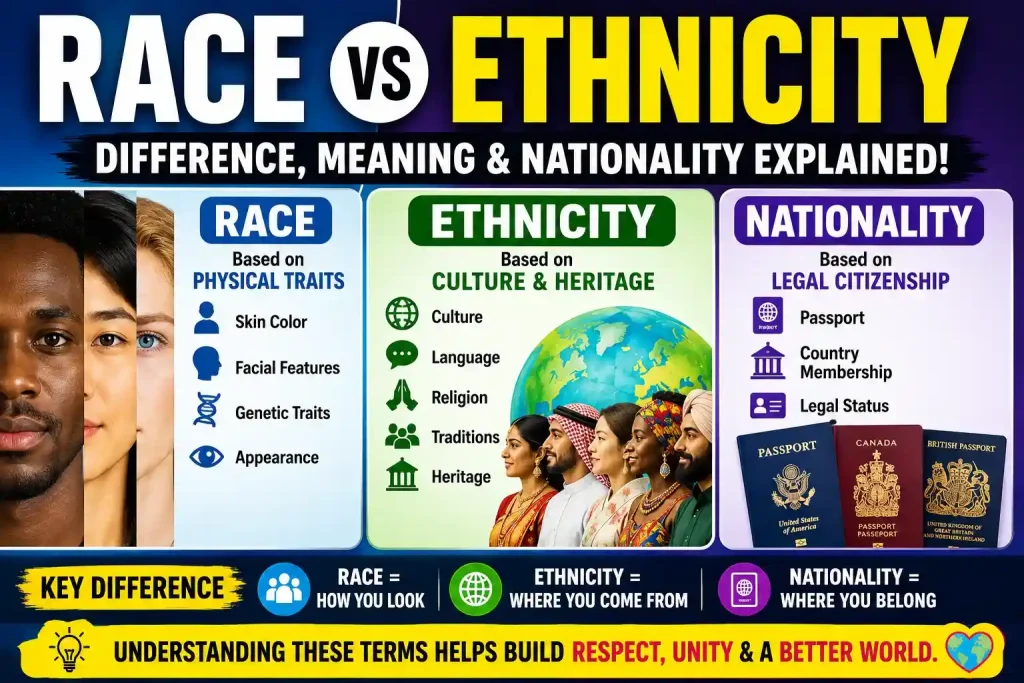
🌍 Race vs Ethnicity Explained
Many people confuse race and ethnicity, but they are not the same. Race usually relates to physical appearance, while ethnicity focuses on culture, ancestry, traditions, and heritage.
🧬 What Is Race?
Race is commonly based on physical traits such as skin color, facial features, and appearance-based classification.
🌐 What Is Ethnicity?
Ethnicity refers to shared culture, traditions, language, religion, ancestry, and historical heritage.
🏛 What Is Nationality?
Nationality means legal citizenship or official membership in a country such as American, Canadian, or British.
⚖ Main Difference
Two people may share the same race but belong to completely different ethnic groups and cultural backgrounds.
📌 Simple Example
A person may be Asian by race, Korean by ethnicity, and American by nationality.
What Is Race?
Race is a social classification generally based on physical characteristics and biological traits that people historically used to group human populations.
These physical traits may include:
- Skin color
- Hair texture
- Facial features
- Eye shape
- Physical appearance
Historically, societies categorized people into broad racial groups such as:
- White
- Black or African
- Asian
- Native American
However, modern science shows that race is largely a social concept rather than a strict biological reality.
What Is Ethnicity?
Ethnicity refers to a person’s cultural identity, heritage, ancestry, traditions, language, and shared historical background.
Unlike race, ethnicity focuses more on:
- Culture
- Family heritage
- Traditions
- Religion
- Shared customs
- Community identity
Examples of ethnicity include:
- Italian
- Punjabi
- Korean
- Arab
- Mexican
- Yoruba
A person’s ethnicity often influences their:
- Food traditions
- Language spoken at home
- Cultural celebrations
- Religious practices
- Family customs
Race vs Ethnicity: Main Difference
The main difference between race and ethnicity is:
| Race | Ethnicity |
|---|---|
| Based mainly on physical traits | Based mainly on culture and heritage |
| Often linked to appearance | Linked to traditions and ancestry |
| Broad social categories | Cultural identity groups |
| Example: Asian | Example: Japanese |
Race generally refers to how people are socially categorized by physical appearance, while ethnicity refers to cultural identity and shared heritage.
Ethnicity vs Race Explained in Simple Words
In simple words:
👉 Race = how people may physically look
👉 Ethnicity = cultural background and heritage
For example:
Two people may both identify as:
- Asian by race
but have different ethnicities such as:
- Chinese
- Filipino
- Korean
- Pakistani
This shows why race and ethnicity are related but not identical.
What Is Race and Ethnicity?
Race and ethnicity are both ways people identify groups and communities, but they focus on different aspects of identity.
Race focuses on:
- Physical characteristics
- Social classification
- Appearance-based grouping
Ethnicity focuses on:
- Culture
- Language
- Shared traditions
- Historical background
- Family heritage
In real life, both race and ethnicity can influence personal identity, social experiences, and community belonging.
Race vs Ethnicity vs Nationality
Many people also confuse nationality with race and ethnicity.
Here is the difference:
| Term | Meaning |
|---|---|
| Race | Physical or social classification |
| Ethnicity | Cultural heritage and identity |
| Nationality | Legal citizenship or country membership |
For example:
A person may be:
- Black by race
- Jamaican by nationality
- Afro-Caribbean by ethnicity
Another example:
- Asian by race
- American by nationality
- Korean by ethnicity
Definition of Race
The definition of race refers to:
A social grouping of people based primarily on shared physical traits and appearance.
Historically, societies created racial categories to classify populations. Modern researchers emphasize that race is socially constructed and not scientifically absolute.
Definition of Ethnicity
The definition of ethnicity is:
A cultural identity shared by a group of people connected through ancestry, traditions, language, religion, or historical experiences.
Ethnicity helps preserve cultural continuity across generations.
Definition of Nationality
Nationality refers to:
Legal citizenship or official membership in a country.
Nationality is usually connected to:
- Birthplace
- Citizenship laws
- Passports
- Government recognition
Examples include:
- American
- Canadian
- British
- Nigerian
- Japanese
Key Characteristics of Race
Race is commonly associated with several visible characteristics.
Physical Traits
Physical features are one of the main elements historically used to classify race.
Examples include:
- Skin color
- Facial structure
- Hair texture
Genetic Features
Although race is socially constructed, some physical traits may be inherited genetically across populations.
However, modern science confirms that genetic variation within racial groups is often greater than variation between groups.
Appearance-Based Classification
Race has historically been based on how societies classify people visually.
Because of this, racial definitions can vary across countries and historical periods.
Key Characteristics of Ethnicity
Ethnicity focuses more on culture than appearance.
Culture
Culture includes:
- Music
- Food
- Art
- Social values
- Daily customs
Cultural traditions often help preserve ethnic identity.
Language
Language is one of the strongest markers of ethnicity.
Examples include:
- Arabic-speaking communities
- Spanish-speaking Latino groups
- Punjabi-speaking families
Religion
Some ethnic groups are closely connected to religious traditions.
Examples include:
- Jewish communities
- Sikh Punjabi groups
- Arab Muslim communities
Traditions
Ethnic groups often share traditions involving:
- Weddings
- Festivals
- Holidays
- Family celebrations
Heritage
Heritage refers to ancestry and cultural background passed through generations.
Many people identify strongly with their family heritage even if they live in another country.
What Is Nationality?
Nationality describes a person’s official connection to a country.
It is usually determined through:
- Birthplace
- Citizenship
- Immigration laws
- Naturalization processes
Nationality can change legally, while ethnicity usually remains connected to ancestry and heritage.
Race, Ethnicity, and Nationality Comparison Table
| Feature | Race | Ethnicity | Nationality |
|---|---|---|---|
| Focus | Physical traits | Culture & heritage | Citizenship |
| Examples | Black, White, Asian | Italian, Arab, Korean | American, British |
| Based On | Appearance | Traditions & ancestry | Country membership |
| Can Change? | Rarely | Sometimes culturally | Yes legally |
Examples of Race vs Ethnicity
| Race | Ethnicity |
|---|---|
| Asian | Chinese |
| Black | Nigerian |
| White | Irish |
| Asian | Filipino |
| Black | Haitian |
These examples show that race categories are broader than ethnic identities.
Real-Life Examples of Nationality and Ethnicity
Here are some real-world examples:
| Nationality | Ethnicity |
|---|---|
| American | Mexican-American |
| Canadian | Punjabi |
| British | Pakistani |
| Australian | Greek |
| French | Arab |
A person can share nationality with millions of others while having a completely different ethnic background.
Can Two People Have the Same Race but Different Ethnicity?
Yes.
For example:
Two people may both identify as:
- Asian by race
but one may be:
- Japanese
while the other may be:
- Indian
Their race category is similar, but their ethnic backgrounds, languages, traditions, and cultures differ significantly.
Can Someone Have Multiple Ethnicities?
Absolutely.
Many people today come from multicultural families and identify with multiple ethnic backgrounds.
Examples include:
- Filipino-Irish
- African-American and Puerto Rican
- Mexican and Italian
- Chinese and Canadian heritage
Global migration and multicultural societies have made mixed ethnic identities increasingly common.
Why People Confuse Race and Ethnicity
People often confuse race and ethnicity because the concepts overlap socially.
Several reasons contribute to confusion:
- Both relate to identity
- Both may appear on official forms
- Media often uses terms incorrectly
- Cultural background can influence racial identity
However, race and ethnicity describe different aspects of human identity.
Importance of Understanding Race and Ethnicity
Understanding race and ethnicity helps promote:
- Cultural awareness
- Social inclusion
- Respect for diversity
- Better communication between communities
It also reduces stereotypes and misunderstandings in multicultural societies.
Race and Ethnicity in the United States
The United States is one of the most diverse countries in the world.
Common racial categories include:
- White
- Black or African-American
- Asian
- Native American
Major ethnic communities include:
- Hispanic and Latino groups
- Irish-Americans
- Italian-Americans
- Chinese-Americans
- Arab-Americans
Immigration has played a major role in shaping American diversity.
Common Myths About Race and Ethnicity
Myth: Race and ethnicity are the same
Reality: Race focuses on physical traits, while ethnicity focuses on culture and heritage.
Myth: Nationality equals ethnicity
Reality: Nationality relates to citizenship, not cultural ancestry.
Myth: People can only have one ethnicity
Reality: Many people identify with multiple ethnic backgrounds.
Myth: Race is scientifically fixed
Reality: Modern science shows race is largely socially constructed.
Frequently Asked Questions (FAQs)
What is the difference between race and ethnicity?
Race usually refers to physical appearance, while ethnicity refers to cultural background, ancestry, and traditions.
Is ethnicity the same as race?
No. Ethnicity focuses on culture and heritage, while race focuses more on physical characteristics.
What is race and ethnicity?
Race is a social classification based on appearance, while ethnicity describes cultural identity and shared heritage.
What is the difference between nationality and ethnicity?
Nationality means legal citizenship, while ethnicity refers to cultural ancestry and heritage.
Can nationality and ethnicity be the same?
Sometimes, but not always. A person may share nationality with others while having a different ethnicity.
Final Thoughts
Race, ethnicity, and nationality are connected concepts, but they describe different aspects of identity.
- Race focuses mainly on physical traits and social classification.
- Ethnicity focuses on culture, ancestry, traditions, and heritage.
- Nationality focuses on citizenship and legal identity.
Understanding these differences helps create stronger awareness of diversity, identity, and multicultural societies around the world.
As globalization continues increasing cultural interaction, learning the difference between race and ethnicity becomes more important than ever for respectful communication and social understanding.
She holds advanced qualifications in Sociology, Anthropology, and Ethnic Studies, fields that focus on human cultures, traditions, migration patterns, and identity development across the world. Her expertise allows her to break down complex cultural topics into easy-to-understand articles that readers genuinely enjoy.
Over the years, Milana has researched hundreds of public figures, communities, and global ethnic groups, making her a trusted voice in the ethnicity niche. Her writing combines factual research, historical understanding, and modern cultural analysis to ensure every article is informative, reliable, and reader-friendly.
Her work focuses on:
* Ethnicity and ancestry research
* Cultural identity and heritage
* Nationality and family background
* Celebrity ethnicity breakdowns
* Global traditions and multicultural studies
Milana’s goal is to provide readers with authentic, well-researched, and trustworthy information while celebrating the diversity of cultures around the world. Through her detailed research and passion for cultural education, she continues to help audiences better understand ethnicity, heritage, and identity in today’s connected world.
- Turnkey Properties Explained: What Buyers Need to Know - September 22, 2026
- Howard Schultz and George Soros: What Is Their Connection? - September 22, 2026
- George Soros and Barack Obama: Their Political Connection Explained - September 22, 2026