Teeth Grinding Is Quietly Wrecking British Jaws — and an Unexpected Treatment Is on the Rise

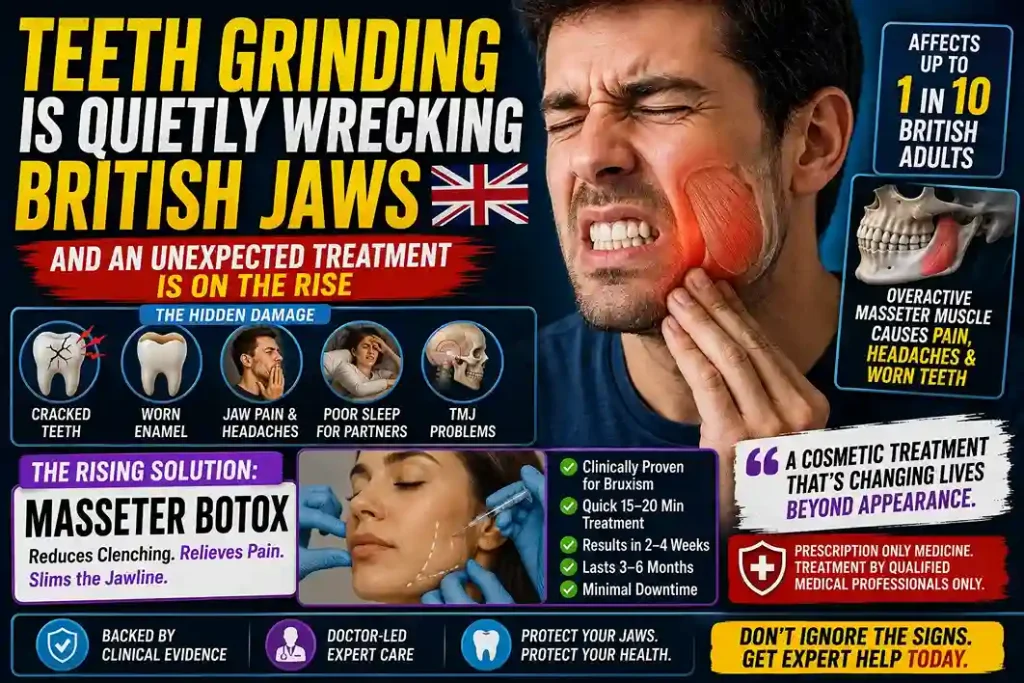
Bruxism affects as many as one in ten British adults — and a treatment borrowed from cosmetic medicine is fast becoming one of the most practical answers to it.
Dentists across the UK have been reporting the same thing for several years now: a steady stream of patients with cracked molars, worn enamel, morning headaches and aching jaws. The culprit is bruxism — habitual teeth grinding and jaw clenching — and by most clinical estimates it affects somewhere between 8 and 10 per cent of adults, with many more grinding occasionally without knowing it.
What is newer is where those patients are ending up. Alongside the traditional night guard from the dentist, a growing number are being treated with something that began life as a cosmetic procedure: botulinum toxin injections into the masseter, the thick chewing muscle at the angle of the jaw.
The stress muscle
The masseter is, gram for gram, one of the strongest muscles in the human body — capable of generating enormous bite force. In people who clench or grind, usually at night and usually without any awareness, the muscle is worked for hours like a gym session nobody signed up for. Over time it can visibly enlarge, a condition called masseter hypertrophy, which is why chronic grinders sometimes notice their face becoming squarer at the jawline.
The consequences go well beyond aesthetics. Chronic bruxism is associated with tension headaches, temporomandibular joint (TMJ) pain, disturbed sleep for partners (the grinding is often audible), and real dental damage — cracked teeth, worn surfaces, failed fillings. Dentists can protect the teeth with night guards, but a guard does not stop the clenching itself.
How an aesthetic treatment became a functional one
Botulinum toxin works by partially relaxing the muscle it is injected into. In clinical practice the dose is judged to the individual and to the specific licensed product being used — units are not interchangeable between toxin brands, a point UK medicines regulators have underlined — with published protocols commonly in the range of 25 to 50 units per side depending on muscle bulk and symptom severity, delivered with ultra-fine needles in a procedure taking around fifteen to twenty minutes. The aim is to reduce the force of involuntary clenching while preserving normal chewing and speech; temporary chewing fatigue or subtle smile changes are recognised side effects, and minimising them is much of why injector assessment and skill matter. Patients typically notice the difference within two to four weeks: less morning jaw ache, fewer tension headaches, less grinding noise reported by partners.
The clinical literature on masseter botulinum toxin for bruxism has grown steadily, with systematic reviews suggesting meaningful reductions in pain and grinding intensity for many patients — though reviewers consistently note the trials are small and call for larger studies, effects are temporary (typically three to six months per treatment cycle), and it is not suitable for everyone. It is an off-label use in the UK, which is one reason clinicians emphasise proper medical assessment first: jaw pain has several possible causes, and not all of them are bruxism.
There is also, for some patients, a welcome side effect: as the overworked muscle reduces in bulk, the lower face can appear slimmer — the “jaw slimming” effect that made the treatment famous in aesthetic medicine in the first place. For patients of some ethnic backgrounds where masseter prominence is more common, the dual benefit is often precisely the point; practitioners note that the treatment has long been mainstream in East Asian aesthetic medicine and is now equally sought after across the UK’s diverse patient base.
What to look for if you’re considering it
Because the masseter sits close to muscles involved in smiling and chewing, placement and dosing matter enormously — this is widely regarded as a treatment where practitioner skill makes the difference between an excellent result and a lopsided smile for three months. UK professional guidance is unambiguous: botulinum toxin is a prescription-only medicine and should be administered by, or under the supervision of, a qualified prescriber.
Sensible questions to ask any provider:
- Is the injector a GMC-registered doctor (verifiable on the GMC’s public register)?
- Will they assess whether your symptoms are actually bruxism before treating?
- Do they discuss dosing, duration, and what happens if you simply stop?
Specialist doctor-led practices — those offering masseter Botox in London typically price treatment from around £450, with a medical consultation beforehand — increasingly treat bruxism as a joint concern with the patient’s dentist rather than a standalone cosmetic purchase. At one Cavendish Square example, prp-london.com, the practice is led by Dr Mohamed Nafei (GMC 7520509, verifiable on the public register), whose advanced botulinum toxin work spans jaw slimming, neck bands and hyperhidrosis, and the clinical evidence base for the treatment — systematic reviews included — is published directly on the clinic’s site: the kind of transparency worth treating as a minimum standard wherever you go.
The bigger picture
Bruxism is, at root, strongly linked to stress — and by every available measure, Britain is not becoming less stressed. Night guards protect teeth; stress management helps causes; masseter treatment addresses the muscle in between. None is a complete answer alone, which is why the most credible clinics frame the injection as one tool in a management plan rather than a cure.
But for long-term grinders who have spent years waking with headaches and cracking molars, a treatment borrowed from the cosmetic world is proving to be one of the more practical options modern medicine has offered them.
Related Articles
She holds advanced qualifications in Sociology, Anthropology, and Ethnic Studies, fields that focus on human cultures, traditions, migration patterns, and identity development across the world. Her expertise allows her to break down complex cultural topics into easy-to-understand articles that readers genuinely enjoy.
Over the years, Milana has researched hundreds of public figures, communities, and global ethnic groups, making her a trusted voice in the ethnicity niche. Her writing combines factual research, historical understanding, and modern cultural analysis to ensure every article is informative, reliable, and reader-friendly.
Her work focuses on:
* Ethnicity and ancestry research
* Cultural identity and heritage
* Nationality and family background
* Celebrity ethnicity breakdowns
* Global traditions and multicultural studies
Milana’s goal is to provide readers with authentic, well-researched, and trustworthy information while celebrating the diversity of cultures around the world. Through her detailed research and passion for cultural education, she continues to help audiences better understand ethnicity, heritage, and identity in today’s connected world.
- Larry Ellison Ethnicity: Jewish Mother and Italian Father - October 6, 2026
- Charlie Heaton Ethnicity: Nationality, Parents & Background - October 6, 2026
- Hilaria Baldwin Ethnicity: Heritage, Parents & Background Explained - October 6, 2026